Related Articles


In a bold statement that has sent shockwaves through the international community, President Donald Trump recently boasted about the success of U.S. forces in capturing Venezuela’s president, Nicolás Maduro. The announcement came on the heels of reports of explosions and military activity across various parts of Venezuela, triggering an intense global reaction.
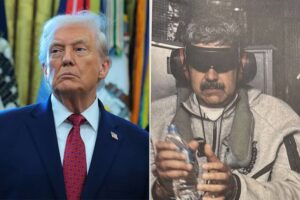
Trump praised the U.S. military, claiming that no country in the world could have achieved such a feat. This remark raises questions not only about the future of Venezuela but also the role the U.S. is playing in global geopolitics.
Reports coming out of Venezuela suggest that the “large scale strike” carried out by U.S. military forces involved an intense bombing campaign that left explosions ringing throughout the country. While the Venezuelan government has yet to confirm the full extent of the damage, it is clear that a significant military operation has unfolded. Images and videos circulating on social media show large plumes of smoke rising from the capital, Caracas, and other major cities.
The United States has long been critical of Nicolás Maduro’s leadership, accusing him of corruption, human rights violations, and mismanagement of Venezuela’s vast oil resources. The country has been facing a severe economic crisis for years, with inflation reaching astronomical levels and millions of citizens fleeing in search of better opportunities. President Trump’s actions, however, raise important concerns about the impact of foreign intervention in a sovereign nation’s affairs.
The capture of Maduro, if confirmed, would be seen by many as a massive win for the U.S. military and the Trump administration. Trump has long made it a priority to remove Maduro from power, viewing the Venezuelan leader as a destabilizing force in the Western Hemisphere. In his statement, Trump proudly claimed that no other country in the world could achieve the military success that the United States has now demonstrated.
This aggressive stance by the U.S. comes at a time when many countries are questioning the role of foreign intervention in Latin America. The region has been plagued by political instability, with several countries grappling with their own internal conflicts and struggles for democracy. Critics of Trump’s actions argue that U.S. intervention is nothing more than a power grab in an effort to control Venezuela’s oil resources and assert American dominance in the region.
Despite these criticisms, Trump remains unapologetic. In his speech, he stated that the U.S. would not allow any rogue state to undermine the values of democracy and freedom. “We do what others cannot do,” Trump declared confidently, making it clear that the U.S. would continue to take a hard stance against any government deemed as a threat to American interests. His words were met with both praise and condemnation, highlighting the divisive nature of U.S. foreign policy.
The international community has been quick to respond to the news of Maduro’s capture. While some world leaders, particularly in the Western Hemisphere, have expressed support for the U.S. military operation, others have denounced it as an illegal act of aggression. Russia and China, two of Venezuela’s main allies, have already issued strong statements condemning the U.S. intervention. Both countries have expressed concerns over the violation of Venezuela’s sovereignty and warned that such actions could lead to further destabilization in the region.

For Venezuela’s citizens, the situation is rapidly evolving into a tense and uncertain crisis. Many people in Venezuela had already been living in dire conditions due to the country’s economic collapse, with widespread shortages of food, medicine, and other essential resources.
The prospect of a foreign military occupation only adds to the anxiety and fear that grips the nation. While some opposition groups within Venezuela may see the capture of Maduro as a potential turning point, others worry that it will only lead to more violence and suffering for the country’s already beleaguered population.
As news of the U.S. military’s strike spreads, there are also reports of protests breaking out in several Venezuelan cities. Supporters of Maduro are taking to the streets to denounce what they see as an illegal foreign intervention. These protests have been met with heavy security presence, with Venezuelan authorities reportedly using force to disperse crowds. The situation is becoming increasingly volatile, and it remains to be seen how the Venezuelan people will respond to the unfolding events.
In Washington, D.C., Trump’s announcement has ignited debates among lawmakers and foreign policy experts. Some view the U.S. military’s actions as a necessary response to Maduro’s authoritarian regime, while others argue that the risks of such intervention far outweigh the potential benefits.
Critics contend that the U.S. is once again overstepping its boundaries by meddling in the affairs of a sovereign nation. Furthermore, there are growing concerns about the long-term impact of such interventions, particularly when it comes to relations with other countries in the region.

Venezuela’s neighbors are also feeling the effects of the military strike. Countries like Colombia, Brazil, and Panama, which have already been dealing with a large influx of Venezuelan refugees, are bracing for even more instability. The social and economic strain on these countries has been immense, and the U.S. intervention in Venezuela threatens to exacerbate an already dire situation.
For the Trump administration, the capture of Maduro could be seen as a key political victory. Trump has faced mounting criticism over his handling of domestic and foreign policy issues, and a successful military operation in Venezuela could provide much-needed momentum for his administration. With the 2020 presidential election fast approaching, the president is likely to use this development to bolster his image as a strong leader who stands up to authoritarian regimes around the world.
However, the potential fallout from this operation could have far-reaching consequences for U.S. foreign relations. While some allies may see the U.S. as a champion of democracy, others could view the military strike as a dangerous precedent for future interventions. The question of whether the U.S. will be able to maintain its influence in Venezuela in the long run is still uncertain, and much will depend on how the situation unfolds in the coming weeks and months.
The world is now watching closely as Venezuela faces its most critical moment in recent history. With Maduro’s capture, the U.S. has made its intentions clear: to assert its dominance in the region and ensure that Venezuela does not remain a haven for authoritarian regimes. But the true cost of this intervention, both for Venezuela and for the United States, will only become evident with time.
As the situation in Venezuela continues to evolve, the Trump administration faces tough questions about its role in shaping the future of the country. Will the capture of Maduro lead to a stable and democratic Venezuela, or will it spark even more violence and chaos? One thing is certain: the world is watching, and the answers to these questions will have profound implications for international relations in the years to come.
For now, President Trump stands by his actions, proud of what he calls a successful mission. His rhetoric has struck a chord with those who view him as a strong, decisive leader. But the road ahead remains uncertain, and the true consequences of U.S. intervention in Venezuela will only be revealed as the situation unfolds in the coming weeks.
In the meantime, the Venezuelan people remain trapped in a state of uncertainty, caught between their own struggles for survival and the looming threat of foreign intervention. As the world holds its breath, the future of Venezuela hangs in the balance.