Related Articles



In a bold revelation, renowned Ugandan singer Moses Ssali, popularly known as Bebe Cool, has explained why he chose to support President Yoweri Museveni over former presidential candidate Kizza Besigye. The reasoning behind his decision may surprise many—it’s all about the candidates’ facial expressions.
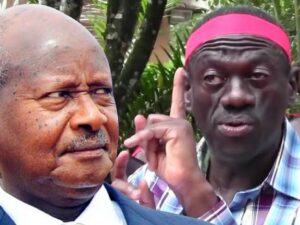
Bebe Cool, who has been a staunch supporter of Museveni for many years, believes that a politician’s facial expressions matter more than most would think. He argued that voters are drawn to candidates who appear calm, approachable, and friendly, and it is these qualities that, in his view, make Museveni the more attractive choice for leadership.
“When Museveni is angry, he wears a baby face. But when Besigye is angry, his face changes drastically,” Bebe Cool said. His words highlight an interesting aspect of political campaigning: the importance of how candidates present themselves, both in demeanor and expression. According to Bebe Cool, this subtle detail has a significant impact on how the public perceives a leader.
“If you look at Besigye when he is angry, his face shows so much intensity that it becomes intimidating,” Bebe Cool remarked. He went on to say that when voters see such a face, they might wonder how the candidate would behave if provoked. “As a voter, you start to ask yourself, ‘If I make this person angry, will they be able to control themselves?'”
In contrast, Museveni’s angry face, according to Bebe Cool, is not as intimidating. “He looks like a baby even when he is angry,” Bebe Cool joked, referring to the President’s calm and more approachable demeanor. For Bebe Cool, these differences in facial expression played a crucial role in his decision to support Museveni over Besigye.
Bebe Cool’s support for President Museveni is not a new development. Over the years, he has made no secret of his political leanings, often publicly backing Museveni even when it was unpopular within certain circles. His father, Bidandi Ssali, ran against Museveni in the past, yet Bebe Cool remained a loyal supporter of the long-time President.
This loyalty to Museveni was evident during the campaigns for the 2021 presidential election. Despite facing criticism from some of his peers in the entertainment industry, Bebe Cool continued to advocate for Museveni. His vocal support included mobilizing fellow artists to perform at Museveni’s campaign rallies, showing his belief that the President’s leadership was what Uganda needed to move forward.
Bebe Cool’s influence as a prominent figure in the music industry has allowed him to mobilize a significant audience for political purposes. During the election campaigns, many artists were either in support of Museveni or opposition figures, like Kizza Besigye or Bobi Wine. However, Bebe Cool’s influence in the arts industry has helped bolster Museveni’s image, especially among younger voters who look up to musicians and entertainers.

This unique position has allowed Bebe Cool to bridge the gap between politics and entertainment. He has consistently used his platform to advocate for the President, even though some of his fellow artists have publicly declared their support for other candidates. Bebe Cool’s efforts to get fellow musicians to support Museveni are just one example of how the entertainment industry has played a key role in shaping the political landscape in Uganda.
Kizza Besigye has long been a prominent figure in Ugandan politics. He has run for president multiple times, always unsuccessfully. Besigye first contested for the presidency in 2001, then again in 2006, 2011, and 2016. Despite his loss in all four elections, Besigye remained a key player in Ugandan politics and a vocal critic of Museveni’s administration.
His political journey has been tumultuous, marked by public protests, imprisonment, and ongoing battles for what he sees as democratic reforms in Uganda. Besigye’s refusal to back down from his political beliefs has earned him both admiration and criticism. His role as the president of the Forum for Democratic Change (FDC) allowed him to rally support from opposition parties and civil society groups. However, with the recent split of the FDC, Besigye has become a more marginalized figure within the political arena.
In 2026, Besigye’s political journey took a new turn with the formation of the People’s Front for Freedom (PFF), a new political party that emerged from the split of the FDC. Despite the formation of this new party, PFF did not field a candidate for the 2026 presidential elections, choosing instead to focus on providing a platform for civil activism and political advocacy.
PFF is now led by Kampala Lord Mayor Erias Lukwago, with Besigye serving as the Chair of the Council of Eminent Persons, a position that prevents him from running for office. This new chapter in Besigye’s political career highlights the ongoing evolution of Uganda’s opposition politics and the challenges faced by leaders like him who continue to fight for political change.
Bebe Cool’s public persona, characterized by his larger-than-life image and outspoken nature, has made him a force to be reckoned with in both the entertainment and political spheres. While many musicians choose to stay neutral or refrain from public political commentary, Bebe Cool has used his celebrity status to support the political causes he believes in.
His decision to support Museveni, despite the political and personal risks involved, demonstrates his unwavering commitment to the President. However, his comments about Besigye’s facial expressions have sparked debates on the role of appearance in politics. For some, it might seem trivial, but for others, it brings attention to the psychological factors that can influence voter behavior, even at the highest levels of government.
In a world dominated by social media, soundbites, and imagery, the appearance of political candidates has become just as important as their policies. Voters often form opinions based on how candidates present themselves, and facial expressions are a subtle but powerful tool in shaping that perception.

Bebe Cool’s comments highlight the reality that politicians are not just judged on their policies, but also on their emotional reactions and how they project themselves to the public. This makes the management of a politician’s public image more crucial than ever, as voters increasingly take cues from non-verbal communication, such as facial expressions, body language, and tone of voice.
As Uganda continues to evolve politically, Bebe Cool’s influence in the entertainment and political spheres is likely to remain strong. His outspoken support for Museveni and his analysis of facial expressions as a political tool are just a small part of the larger narrative of how Uganda’s political landscape is shaped by various figures from different sectors of society.
Bebe Cool’s comments also serve as a reminder that politics is not just about policies and ideologies but also about the personal connection that leaders establish with voters. For some, a smile can make all the difference in securing their vote.
Bebe Cool’s comments about Kizza Besigye’s facial expressions have sparked mixed reactions from the public. Some have criticized him for reducing politics to something as superficial as a facial expression, while others have found humor in his observations.
Supporters of Besigye, however, argue that such comments are dismissive of the serious political issues at stake in Uganda. They contend that focusing on appearance detracts from the real concerns surrounding governance, human rights, and democratic freedoms.
Despite the controversy, Bebe Cool’s remarks have certainly generated conversation, proving that even the smallest details, like a politician’s facial expression, can become a point of debate in a highly charged political environment.
Bebe Cool’s public discussion about the role of facial expressions in shaping political support offers a fascinating insight into the complex dynamics of Ugandan politics. While his comments may seem trivial on the surface, they highlight the significant role that appearance plays in how voters perceive political candidates. As Uganda looks ahead to future elections, the impact of both public image and personal demeanor will undoubtedly remain a key factor in determining who garners the support of the people.