Related Articles



BY RICHARD DRASIMAKU
ARUA: Friday, July 17, 2026
What began as a baby sized Cocoa industry in Koboko district eight years ago is already turning into a worldwide sensation after the aromatic allure of Kobococo Chocolate stormed the world Market in 2025.
From the heartbeat of West Nile, Natures’ Harvest is manufacturing the Kobococo Chocolate and Cocoa natural drinking powder as the region’s maiden farm export of the premium crop.
Since product samples arrived in the European Union and Asian markets in 2025, demands have rapidly been growing among small to medium farmers growing the tropical green gold alongside high value Coffee and fruit trees.
Although it took many years to get to where it is now, average farm sizes are expanding fast enough to keep in sync with the emerging demands.
One commercial agent, Natures’ Harvest, is walking farmers step by step on to a digital platform with support from the Climate Smart Jobs, an innovative agribusiness initiative in Northern Uganda.
Together with Koboko district cocoa farmers’ cooperative society, the partners are ensuring through training of more farmers that West Nile’s Cocoa agronomy illuminates the dark corners of the region affected by crop failures, loss of livelihoods and household incomes driven by prolonged dry spells, erratic rainfall and declining soil fertility.

Data from the cooperative society indicates that the districts of Maracha, Arua and Arua City, Yumbe, Terego, Nebbi, Zombo and the entire Nile belt districts have joined the sector.
Old Problem, Sustainable Solution
West Nile Sub Region’s many years of dependence on Tobacco growing as the main cash crop created an age-old problem in the region: deforestation. Natural forest trees were indiscriminately cut in droves for curing Tobacco crops in rudimentary burns.
Poverty burden remained high despite many years of hard work. Without national electricity grid in West Nile, industries depended on biomass energy such as wood fuel, Charcoal and the costly WENRENCO’s low generation capacity.
The collapse of the Tobacco industry meant increment of poverty burdens at households and regional level, as indicated by various household and demographic surveys of the Uganda National Bureau of Statistics (UBOS) over the last ten years.
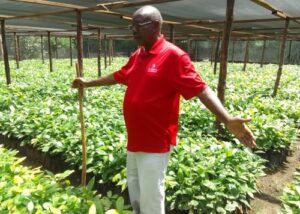
It took one man, James Baba, a veteran politician and diplomat, many years of curiosity to make available a sustainable solution for the old problem. Today, West Nile is a bedrock of agroforestry greenery, thanks to the introduction of the Cocoa industry by the father of Cocoa in West Nile, James Baba, who is also the founding father of Natures’ Harvest.
James Baba represented Koboko district in Parliament as Koboko County Member of Parliament. He also served as Uganda’s Ambassador to Tokyo, Japan and later as the minister of state in the office of the Vice President and minister of state for Internal Affairs.
It was while serving in the office of the Vice President of Uganda, Prof Gilbert Bukenya that James Baba picked up the gospel of wealth creation under the Presidential Four-Acre Model as the initiative took him East, West, North and South of Uganda.
He learned from Masaka that one rural farmer was earning up to UGX.20 million a month from Coffee, Diary, Poultry and Bananas. “Which of these enterprises would bail my people back in Koboko from poverty?” Natures Harvest quotes James Baba as questioning himself in their literature.
Cocoa grows where Coffee thrives, he learned. He soon invited the Ministry of Agriculture to conduct extensive soil sampling and testing to establish the Eureka moment for his people. True to his convictions, Cocoa was introduced to the West Nile Sub region.
James Baba later discovered that a distant relative was already growing and casually marketing his Cocoa powder within Arua Municipality, from his backyard tree in Ayelembe in Vurra county, Arua district.
His experience became a Launchpad for rural farmers in the district to grow their wealth on Cocoa trees. James Baba visited his Cocoa plantation composed of just 15 Cocoa trees being cared for casually by an old man without major track record or school background.
Cocoa trees from the old man’s orchard produced exceptionally big pods, attractive appearances and juicy flavour which he mechanically grounded into powder and mixed with Vanilla to can and sell at a paltry UGX. 15,000 a tin for willing buyers. With this evidence beyond reasonable doubt that Cocoa does not just do thrive but bloom in the watershed of West Nile, the political leader pressed forward to mobilize farmers to take up the enterprise.
Pioneer Ambassadors
Natures Harvest began the Cocoa revolution in West Nile sub region with just 50 small scale farmers. They were brought together under Koboko district farmers association, which later transformed into Koboko district farmers’ cooperative union (KODICO).
Their primary enterprise was Rice and fruits which individual income could not beat the UGX.20 million a month mark. Fruits were attacked by harmful fruit flies to extinction as the cost of management did not make business sense, let alone the safety issues which came with pesticide applications.
Muni University then joined the struggle with expertise as it introduced the Faculty of Agriculture. Cocoa Value sector players met to brainstorm the future of West Nile with a brand-new cash crop – Cocoa. The conference deeply benefitted from the experience and expertise of Fabio Kowumo, a representative of ICAM chocolate, one of the major players in cocoa farming in Africa.
In 2018, the first major Cocoa Nursery bed was established in Kumiro in Koboko district on land provided by the former minister, James Baba, with viable seeds from Bundibugyo district.
The Nursery raised, hardened and climatically conditioned up to 30,000 seedlings for the first 60 farmers to plant and grow after rigorous training. It was not just the birth of a Cocoa industry but a premium world class cash crop revolution unfolding in the eyes of residents.
From 2020 to 2025, through the Natures Harvest Uganda, a company formed by Baba and Family, seedlings were distributed free to interested farmers provided the person had attended the free training and prepared their gardens with holes and shade plants.
ICAM provided the consultancy expertise in off-taking the initial dry beans at UGX. 26,000 a kilo. Natures’ Harvest began by paying every farmer UGX. 9,000 a kilo for dry beans, then raised to UGX. 15,000 and eventually UGX. 20,000 a kilo as the UGX. 6,000 went towards recovering its investment in Cocoa seeds procured for farmers, trainings and transportation among others.
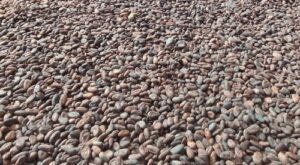
By the year it set the price at UGX. 20,000 a kilo, those with 20 kilograms went home with 400,000 a season while the best farmer received life changing two million shillings from 100 kilograms of dried Cocoa beans. Testimonies went wild as more farmers registered for business.
Elly Asiki, the chairperson of Koboko Cocoa Farmers’ Cooperative Society says the impactful results are being scaled for more farmers for the sustainability of the industry.
“I abandoned politics as the LC3 chairperson of Dranya Sub County to engage in Cocoa growing. The testimonies from farmers were simply irresistible” a smiling Asiki said during this story interview.
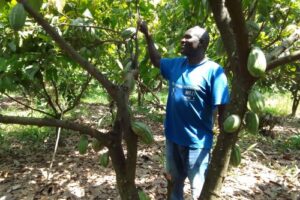
Asiki began with an acre of cocoa which he spaced at 75m x 60m. Now he has increased to five acres. As his Cocoa pods bulging in size, he picks ripe ones every two weeks. His target is to expand in phased manner to ten acres over the next two years. His income is already sumptuous to the poor eyes in a region dominated by illicit business of cross-border smuggling.
Pipeline to Success
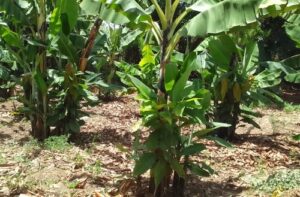
Cocoa growing is less labor intensive compared to Tobacco growing. When intercropped with fast maturing shade trees such as bananas and leguminous beans, Cocoa nourishes the soil with fertility rather than depleting it. Such a field of trees is a 60-year bank of wealth from which the grower keeps harvesting money if well managed before the grower can think of replanting fresh young ones.
Asiki’s production records look super impressive for a region without prior experience in the value chain. His major preliminary beans harvested in 2024 went into seed multiplication required for setting up a firm foundation of the sector.
Asiki’s Cocoa bean harvest has peaked at 600 Kilograms a year, enough motivation for other sector players to rush in. Canaan Global, a South Korean company contributed to the sector by supporting training of 268 farmers consisting of 56 women to grow Cocoa for its industrial up take.
Going digital
Developing an international value chain in a context of local mindset, novel cash crops and changing climatic conditions has never been easy for players. The task at hand now is therefore for Natures’ Harvest to translate training materials into language best understood by rural farmers to significantly improve extension service provision. A partner, Climate Smart Jobs, an innovative agribusiness initiative for Northern Uganda came in handy with support for a digital platform accessible to groups of remote farmers.
Through such a platform, input dealers, extension service providers and foreign players can connect to Cocoa agribusiness sector in the West Nile and reduce the cost of doing business while eliminating exploitative middlemen.
Market prices within the click of a platform or a website, thanks to the penetration of climate smart technologies – solar, internet, radio and smart mobile phones in rural Africa.
Climate Smart Jobs has funded the development and deployment of a digital Mobile Phone Application, known as Wiigot for local farmers.
What Natures Harvest is creating operates on similar model and principles. Code by Code, the online App is nearing completion and compliance testing in line with International Telecommunications requirements. It is available on Apple Store, but its deployment for Cocoa growers in Android operating systems is yet challenging.
Chris Boboli, the Application Developer says the platform is set for deployment in 2027 as Engineers and agronomic researchers from the National Coffee Research Institute (NaCORI) have reviewed the technology.
“Data being fed into the system include the location of the farmers, the size of their Cocoa plantation, production and sales records,” Boboli told this publication.
A section for the current market price of cocoa has been embedded in the App. Geo locating the crop means compliance to the European Markets most interested in checking that premium cash crops comply with the EU agroforestry regulation on Coffee and Cocoa.
Henry Baba, a Son to James Baba is the manager of Natures’ Harvest Uganda. He says, “the arrival of the digital platform means so much for local farmers in terms of identifying quality inputs for their crops including organic pesticides, fertilizers and certified seed dealers.”
The other he says will be the traditional market prices. The Company phased out free seedling distributions in 2016, believing that sustainable project ownership comes at a price from serious farmers.
Shelf-Life
Inside one supermarket in Arua City, there is a frenzy among curious customers seeking to dip their teeth into the tasty aromatic bars of Kobococo Chocolate. The Chocolate entered the list of groceries in 2024 as Natures’ Harvests engaged in aggressive promotion activities.
Sweet preservatives give it long shelf life and antioxidation flavour once open beyond the glowing wrappers. A permanent taste of luxurious West Nile for the wealthy yacht riders around the world. To promote buy Uganda, build Uganda, Natures Harvests is selling each bar at UGX. 15,000 for residents while tourists fork a different dollar price.
With Natures’ Harvest Cocoa beans export license, Koboko district Farmers’ Cooperative Society still needed a companion for value addition to export finished product rather than raw materials and fetch better income. In 2025, the Cooperative society completed the construction of a Cholate Factory in Koboko Town with support with South Koreans.
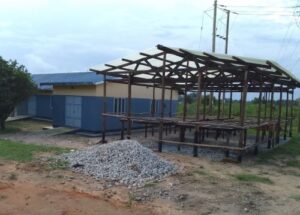
The factory is waiting for commissioning to give extra wings to the premium cash crops to officially take to the sky in bulk export consignments. Major bean importers are not waiting any longer to access the quality of the aromatic West Nile beans refined by the hot temperate temperatures of West Nile.
Canaan Global, a South Korean company has firmly set its eyes on the sector, providing seed capital to the cooperative society to buy for them as much Cocoa beans as it can be available within Koboko and beyond.
The other is Kijami Table, also a South Korean company supplementing the Canaan Global. Their believe in processing of Cocoa into various products from Uganda introduces a clear pipeline for sustainable wealth and job creation for Uganda’s population employed in the value chain.