Related Articles

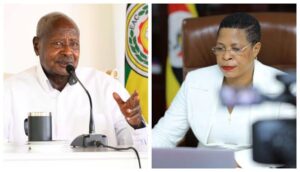
President Yoweri Museveni has once again stirred national debate on political accountability by proposing a constitutional amendment that would allow citizens to recall Members of Parliament (MPs) who fail to serve their constituents effectively. Speaking during a campaign rally in Butambala, Museveni argued that Ugandans already possess the democratic power to demand accountability from their leaders, but in practice, many voters rarely exercise this right. According to him, this gap has allowed some legislators to neglect their duties once elected, leaving the very people who trusted them in office disappointed and unrepresented.
The President emphasized that the National Resistance Movement (NRM) government has given citizens significant influence over leadership at all levels, from Local Council (LC1) chairpersons to district leaders, including constituency MPs and District Woman MPs. Despite this empowerment, Museveni expressed concern that many elected representatives fail to remember their responsibilities once they assume office.
He recounted discussions with local youths, who told him that while they elect MPs, these leaders often forget the people who put them in office. Museveni described this disconnect as a serious flaw in Uganda’s democracy, arguing that voters should be able to hold their leaders accountable before the next election cycle.
To address this challenge, Museveni proposed restoring the “Right of Recall,” a mechanism that would allow voters to remove an MP before completing the five-year term if the legislator fails to meet their expectations. He stressed that this provision existed during the early years of the National Resistance Councils, immediately after the bush war, but it was removed when Uganda transitioned to a multiparty system.
“If we elect an MP and they do not do what they were sent to do, we should bring them back,” he said, highlighting the importance of continuous accountability in governance. Museveni added that this system would encourage MPs to remain in close contact with their constituents and fulfill the promises made during campaigns.
The President noted that under the current system, citizens often have no recourse until the next general election, which can leave constituencies unrepresented for several years. By introducing a recall mechanism, Museveni argued, voters could take direct action when their MP fails to deliver on commitments, thereby reinforcing the principle of public service. He proposed a process whereby citizens could gather signatures to trigger a recall, ensuring that the measure reflects widespread public dissatisfaction rather than personal or partisan grievances.
Legal experts, however, have pointed out that the proposal faces significant constitutional and practical hurdles. Article 84 of Uganda’s Constitution already outlines the grounds for recalling an MP, including misconduct, incapacity, or persistent desertion of the electorate. However, the 2005 amendment to Article 84 introduced clause 7, which limits the right of recall exclusively to the Movement political system. Since Uganda now operates under a multiparty system, courts and legal authorities have ruled that the recall provision is currently suspended, meaning it cannot be applied under existing law. This legal contradiction raises questions about how quickly and effectively Museveni’s proposal could be implemented.
Even if reinstated, the recall process would not be simple. It would require a petition signed by at least two-thirds of registered voters in a constituency before the Electoral Commission could intervene. Following the submission of such a petition, the Commission would conduct a thorough inquiry to verify the claims against the MP and decide whether their seat should be declared vacant. This process ensures that recall is used responsibly, but it also means that removing underperforming MPs would remain a demanding and time-consuming exercise.

Despite these challenges, Museveni argued that restoring the recall provision is essential to strengthening Uganda’s democracy. He suggested that political accountability cannot be left solely to periodic elections, pointing out that voters must be empowered to act when leaders fail to deliver. According to him, the NRM government has historically prioritized citizen participation and has created mechanisms to ensure that leaders remain answerable to their constituencies, but these mechanisms need to be updated to match contemporary political realities.
The President’s proposal has sparked reactions from various quarters. Political analysts note that reinstating the right of recall could shift power significantly toward citizens, giving them more control over their representatives and fostering a culture of accountability. Some opposition figures, however, have expressed concerns that the recall mechanism could be politicized or manipulated, emphasizing the need for clear legal safeguards to prevent abuse. The debate reflects broader tensions between empowering citizens and maintaining political stability in a multiparty democracy.
Museveni highlighted that the recall system is not meant to punish MPs arbitrarily but to ensure they perform their duties faithfully. He pointed out that many MPs are elected on promises they never fulfill, leaving citizens frustrated and undermining public trust in governance. By allowing voters to act before the end of a term, the President believes the recall provision will motivate legislators to remain engaged with their constituents and prioritize their needs.
The proposed constitutional amendment also touches on broader issues of civic engagement and political culture in Uganda. Museveni noted that citizens have the power to elect and remove leaders but often remain passive, either due to lack of awareness or political apathy. He urged Ugandans to exercise their democratic rights actively and hold elected officials accountable, stressing that true democracy goes beyond voting every five years—it requires continuous oversight and participation.
Legal commentators say that if Museveni’s proposal is adopted, the Electoral Commission will play a crucial role in ensuring transparency and fairness throughout the recall process. The Commission would need to establish clear guidelines for signature verification, timelines, and inquiries to prevent abuse or political manipulation. Implementing these measures would require careful planning and coordination, but experts agree it could strengthen democratic governance in Uganda.
Observers also point out that the historical removal of the recall provision coincided with Uganda’s transition to a multiparty system, reflecting a broader shift in political dynamics. Restoring it now would mark a significant step toward increasing citizen influence over parliamentary representation and reasserting the principle that elected officials must remain accountable to the people at all times.

While practical and legal challenges exist, Museveni’s proposal resonates with citizens frustrated by MPs who fail to deliver on campaign promises. Many Ugandans have expressed support for mechanisms that allow them to remove underperforming representatives, arguing that the ability to recall MPs would encourage better governance, responsiveness, and transparency in public office.
The President emphasized that the recall provision is about fairness and responsibility, not about political vendettas. He argued that voters should have the right to act when MPs fail to represent their interests effectively, and this system would give ordinary citizens more leverage to demand results from their leaders.
Political analysts note that introducing recall mechanisms in a multiparty context will require careful balancing to prevent misuse, but if implemented effectively, it could enhance accountability, deter corruption, and ensure that MPs remain focused on their constituents’ needs.
Museveni’s proposal also highlights the tension between entrenched political systems and citizen empowerment. The recall mechanism challenges the idea that MPs are secure in office for fixed terms, insisting instead that public service is a continuous responsibility and that elected officials must constantly prove their worth to the people.
The discussion is likely to continue in Parliament, among legal scholars, and across civil society, as Uganda navigates the complexities of restoring recall powers in a modern democratic framework. How the amendment is framed, implemented, and safeguarded will determine its effectiveness in holding MPs accountable.
Even as debates continue, the proposal has sparked national interest and discussion, encouraging citizens to think critically about their role in governance. It serves as a reminder that democracy is not just about electing leaders but also about actively ensuring that they remain accountable.
Ultimately, Museveni’s call to restore the “Right of Recall” reflects an effort to strengthen democratic institutions, improve the performance of MPs, and create a political culture where citizens are empowered to demand results. Whether the amendment succeeds will depend on legal interpretation, parliamentary support, and citizen engagement, but it marks a significant step in discussions on political accountability in Uganda.