Related Articles



BY Robert Mone
LAMWO: MONDAY, AUGUST 4, 2025
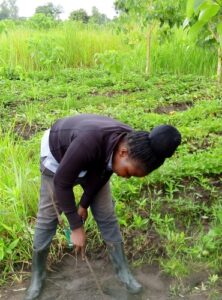
Dorcus Anyiri, is a single mother at block 12, Zone 5B, a refugee settlement in Lamwo district who fled from unrest in South Sudan in 2017.
Since her arrival, Anyiri has engaged in nursery bed management and tree planting to enhance her family’s livelihood, turning part of the 30m by 30m plot allotted to her into a Nursery Bed for Jackfruit, tick, Hass Avocado as well as vegetables such as tomatoes and eggplants.
“I came to Uganda in 2017 as a single mother of three children and helpless before embracing raising tree seedlings in the nursery bed. This business is helping me get some income to pay fees of my children at Glory land Nursery and Primary school-Paluda,” explains Anyiri.
The income from the seedlings is reinvested into a small-scale Silver fish and tomato business.
Anyiri is one of the refugees for whom tree growing has become a turning point for livelihoods and reforestation among South Sudanese refugees.
Paluda settlement in Lamwo district was established in 2017 and it hosts 69,392 South Sudanese refugees integrated with the host community.
According to a report by the United Nations High Commissioner for Refugees 2019-2020, Palabek refugees face a range of critical needs, including access to adequate food, clean water, shelter, healthcare, education, and protection from violence.
The report also listed llivelihood opportunities, financial inclusion, Environmental Protection, Social Inclusion and Community Integration as areas that are also crucial for their self-sufficiency and well-being.

In 2022, Kijani Forestry rolled out reforestation efforts across Acholi sub-region in partnership with Palladium through Climate Smart Jobs.
Since then, with support from Kijani forestry, Lamwo district has planted close to 2,000,000 Trees focusing on farmer partnerships for sustainable charcoal production, with initial harvests expected in the fifth year and subsequent harvests every three years.
This model focuses on planting fast maturing tree species that the farmers can harvest for charcoal burning, construction works firewood or sale to get some income alongside planting the traditional tree species to restore the depleted forest as a result of human activities like charcoal burning, settlement, construction of shelters and tilling land for agriculture.
Michael Tebere, Director Partnership and Government at Kijani Forestry the company has planted from 115,000 in 2020 to 14 million by the end of 2024 across Acholi, Lango part of Bunyoro and West Nile sub regions.
According to Tebere, the company is working on three models of in tree growing like Nursery hub model, Restoration Model, and the business model so that farmers adopt and build resilience to the climate change.
“We have invented new industry of charcoal farming that the government is working on the policy document to regulate the sector operations involving tree survival incentives where tree farmers are paid some money for growing trees, Biochar where charcoal debris are converted in to organic matters to support agriculture especially managing the moisture content for perennial crops like Coffee and Cocoa during dry season and carbon credits for the tree farmers.” Tebere explains
Gatwal Omuk who came to Uganda in 2014 is another farmer who has established a 4-acre tree garden of fast maturing woodlots and now is selling the products to meet his daily needs.
Omuk hired land to plant trees in Palengo Cell, Kal Ward, Palabek Kal town council.
“I came to Uganda in 2014 and found this area bare without any trees, initially I planted bananas and in 2020 I got involved in planting trees which will help us a lot in making some money, have easy access to firewood and also act as a wind break for strong winds,” Omuk said.
He noted that shortage of firewood has significantly contributed to anti-social practices such as stilling firewood by the refugees from the host community that had been causing tension between the people in the settlement and neighboring communities, dependence on handouts from UN-Refugee agency and other partners working on humanitarian services.
Beyond tree plantation, some refugees have undertaken intercropping such as planting trees alongside Bananas and annual crops to boost food security and bolster family development though they continue to live in camps.
Martin Anywar, Energy Focal Person for Acholi sub region says, much as tree growing is picking up, environment destruction is still very high due to harvesting of firewood for cooking, baking bricks, burning charcoal that put a lot of risks on human health and Environment.
“Most of our people are using biomass which is not sustainable since many people are not planting more trees yet they harvest more. A case in point is schools that use this firewood to prepare meals for children,” Anywar Explained.
Alternative sources of energy for the region are still minimal and the available clean energy sources tend to be unreliable and expensive making sustainable use of forest products difficult.
In 2021, Acholi Technical working committee on charcoal was formed to develop a law on sustainable harvest of forest products.
This committee is yet to start implementing the regulations because the office of the Attorney General is yet to advise on the ordinance.
According to Global forest watch, from 2002 to 2024, Lamwo district lost 21 hectares of humid primary forest cover, making up 1.3% of its total tree cover loss in the same time period.
From 2001 to 2024, Lamwo lost 167,000 hectares of tree cover, of which, 98% of tree cover loss occurred in areas caused by wildfire resulting into deforestation.
In Lamwo the peak fire season typically begins in mid-November and lasts around 15 weeks, with 485 Visible Infrared Imaging Radiometer Suite fire alerts reported between 29th of July 2024 and 28th of July 2025 and this was considering high confidence alerts only.
Martin Anywar Energy focal person for Acholi Sub region who doubles as the Kitgum District Environment officer has rallied the locals to plant trees on the vast land available in Northern Uganda.
He said this will help to preserve and protect the traditional tree spices and conserve the environment.
The local tree species are also harvested for medicinal purpose, meanwhile conventional species like Eucalyptus are grown for timber.
The production of this story was supported by InfoNile in partnership with Palladium under the Climate Smart Jobs.