Related Articles

President Yoweri Kaguta Museveni’s campaign visit to Kagadi District turned into a defining political moment, clearly showing renewed strength and momentum for the ruling National Resistance Movement (NRM).
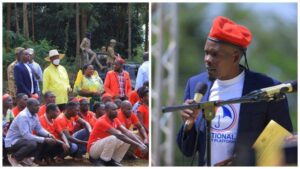
The rally, held in Muhorro Town Council, drew thousands of residents from different parts of the district who gathered to listen to the President’s message and assess the political direction of the country. The atmosphere was charged with excitement, songs, and chants as supporters expressed confidence in the leadership of President Museveni and the NRM government.
What made the rally particularly significant was the visible shift in political loyalty among local leaders, especially from the opposition. Many observers described the event as a turning point for Kagadi politics, with the ruling party gaining ground in an area that has previously shown mixed political support. The presence of top national leaders further elevated the importance of the rally and signaled Kagadi’s growing relevance in national politics.
The most striking announcement of the day came when Speaker of Parliament and Second National Vice Chairperson of NRM, Rt. Hon. Anita Annet Among, addressed the crowd ahead of the President. She formally announced that Mr. Brian Asingwire, a senior figure in the National Unity Platform (NUP), had officially defected to the NRM. The announcement was met with loud applause and celebration from supporters who viewed the move as a major political victory.
Among explained in detail that Asingwire was not an ordinary opposition supporter, but a long-serving and influential NUP leader in Buyaga East. She noted that he had dedicated six years to the opposition party and had even served as NUP chairperson in Kagadi District. His decision to withdraw from the opposition race and join the ruling party, she emphasized, was based on personal observation and experience with government-led development in the area.
According to Among, Asingwire’s defection reflects a broader change in mindset among opposition politicians who are now prioritizing service delivery and development over endless political rivalry. She said many leaders are beginning to appreciate that NRM’s stability and long-term planning have brought tangible benefits to ordinary citizens, especially in rural districts like Kagadi.
When President Museveni took the stage, he delivered a wide-ranging address that focused on ideology, history, and development. He reminded the gathering that NRM was founded on the principles of unity, peace, and economic transformation, not politics of division. He stressed that Uganda’s progress depends on rejecting sectarianism based on tribe, religion, gender, or region.
The President took time to explain how African societies functioned before colonial rule, noting that communities survived and prospered through skills, hard work, and production. He said colonialism disrupted this system, but NRM has worked over the years to restore it by ensuring peace, strengthening state institutions, and empowering citizens to engage in productive economic activities.

Museveni highlighted several achievements that he said demonstrate the impact of NRM leadership. He pointed to improved road networks, expanded electricity coverage, better-equipped schools, and improved health facilities across the country. According to the President, these developments are not accidental but a result of deliberate planning and sustained political stability.
Focusing on Kagadi and the wider Bunyoro sub-region, Museveni noted that government investments have steadily transformed the area. He said improved infrastructure has made it easier for farmers to access markets, children to attend school, and patients to reach health centers, thereby improving the overall quality of life for residents.
The President placed strong emphasis on wealth creation through commercial agriculture, urging residents to move beyond subsistence farming. Using simple language, he encouraged households to engage in activities that generate daily food while also producing income for savings and investment, famously referring to working for both “the stomach and the wallet.”
To further illustrate the benefits of industrialization, Museveni cited the example of Mbale Industrial Park, which currently employs more than 44,000 Ugandans. He said such industrial parks play a critical role in job creation, value addition, and reducing youth unemployment, adding that similar initiatives are planned for other regions.
Museveni announced specific commitments aimed at boosting development in Kagadi District. Among these was the construction of a skilling hub that will provide vocational training in practical trades. He explained that bringing skills training closer to the people will empower young men and women to become self-employed and reduce dependence on white-collar jobs.
The President also pledged to rehabilitate the Ndaiga–Kagadi road, acknowledging that poor road conditions continue to affect trade and transportation in the district. He assured residents that government understands the importance of reliable roads in supporting agriculture, business growth, and regional integration.
Addressing farmers’ concerns, Museveni acknowledged delays in the disbursement of coffee funds meant to support production and value addition. He assured the crowd that the issue had been noted and promised that it would be followed up to ensure farmers receive their funds without further delay.

Prime Minister Rt. Hon. Robinah Nabbanja also addressed the rally, delivering a strong message of unity and support. She declared that leaders in Kagadi District were now firmly united behind President Museveni and the NRM, and pledged overwhelming electoral support in the upcoming elections.
Nabbanja revealed that she had conveyed goodwill messages from Kenyan President William Ruto. According to her, President Ruto wished Museveni success and a landslide victory, highlighting the strong relationship between the two leaders and the importance of regional cooperation.
She urged NRM supporters to intensify grassroots mobilization by engaging voters directly at household level. Nabbanja emphasized that door-to-door campaigns would help explain government programs, counter misinformation, and strengthen support ahead of the 2026 general elections.
Rt. Hon. Anita Among later praised President Museveni for safeguarding freedom of worship and maintaining peace among different religious groups. She also commended investments in oil roads in Bunyoro, saying they have opened up the region and attracted both local and foreign investment.
Among highlighted government support to tea farmers, noting that UGX 360 billion had been invested to strengthen the sector and improve farmers’ incomes. She further pointed to major projects such as Hoima City Stadium and the establishment of a public university in Bunyoro as clear signs of the region’s transformation.
She announced another political development, revealing that Mr. David Muhumuza, who had been contesting for the Mwenge North Constituency as an Independent, had stepped down in favor of the NRM flagbearer. This decision, she said, further demonstrated growing confidence in the ruling party.
By the close of the rally, it was evident that NRM’s influence in Kagadi District was steadily expanding. The combination of opposition defections, visible unity among leaders, and renewed development pledges sent a strong signal that President Museveni’s campaign in the region had received a significant boost, positioning the NRM strongly ahead of the next elections.