https://datawrapper.dwcdn.net/2EDfn/1/ []
Breaking News

Museveni’s Son Is Threatening To Kill Me, He Claims To Have Killed Only 22 People Yet He Killed More Than 100 Since Last Week-Bobi Wine Speaks

Ugandan opposition leader Robert Kyagulanyi, widely known as Bobi Wine, has issued a powerful and emotional statement alleging threats to his life and widespread violence against his supporters. His words have sparked fear, debate, and concern across the country.
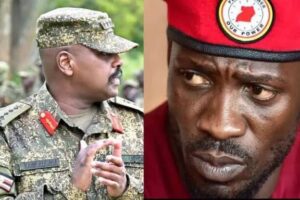
Bobi Wine claimed that President Museveni’s son has openly threatened to kill him. He said these threats were made alongside statements that appeared to celebrate the killing of opposition supporters.

According to Bobi Wine, while the public figure mentioned was 22 people, he believes the real number of those killed since last week is more than 100. He described the situation as alarming and deeply painful.

He said the threats were not just words but were followed by frightening actions at his own home. According to his account, soldiers stationed inside his compound created chaos late at night.

Bobi Wine stated that the soldiers banged on his house doors while singing profanities. He said they challenged the occupants to come outside, creating fear among everyone inside the house.

He added that people in the house believed the soldiers were drunk. This, he said, made the situation even more dangerous and unpredictable.

The opposition leader said his home has effectively been turned into a place of punishment. He alleged that food supplies were blocked, leaving his wife and others inside hungry and distressed.

According to him, the soldiers cut the padlocks on his gates and replaced them with chains. This action, he said, restricted movement and made escape impossible.

Bobi Wine expressed deep concern for the safety of his wife and the people inside his home. He insisted that they are innocent civilians who do not deserve such treatment.

He demanded that the military immediately vacate his residence. He said their continued presence puts lives at risk and violates basic human rights.

The opposition leader described the actions as criminal and abusive. He accused those involved of acting outside the law and using fear to silence political opponents.

His statement has triggered strong reactions from supporters, many of whom expressed anger, fear, and sadness. Social media has been flooded with messages calling for justice and protection.

Human rights activists have urged authorities to investigate the claims seriously. They say any allegation involving threats to life and killings must not be ignored.

Civil society groups have reminded the government that it has a duty to protect all citizens, regardless of political affiliation. They stress that political differences should never lead to violence.

Some voices have called for calm and independent verification of the claims. They argue that facts must be established clearly to avoid further tension.

At the time of his statement, there was no detailed public response from the military or government addressing the allegations. This silence has increased public anxiety.

Political analysts warn that such claims, if not addressed, could deepen mistrust between citizens and state institutions. They say transparency is crucial at this moment.

Bobi Wine said that if such actions can happen to a well-known leader, ordinary citizens may be suffering even more quietly. He called for national and international attention.

He ended his statement with a strong demand for freedom and justice, repeating his call to “Free Uganda Now.” He said silence only empowers oppression.

As Uganda watches closely, many believe the country is at a critical point. How leaders respond to these serious allegations may shape the nation’s peace, justice, and future.

About West Nile

Check Also

Full List!! Here Are The 10 Cabinet Ministers Who Were Badly Defeated In Uganda’s 2026 Parliamentary Elections Uganda’s 2026 general elections have sent shockwaves across the country after ten serving cabinet ministers were badly defeated in parliamentary races. The results marked one of the most dramatic political moments in recent history and clearly showed a shift in voter mood. Across many regions, Ugandans used their votes to express frustration with long-serving leaders. The defeats reflected growing anger over economic hardship, unemployment, poor service delivery, and unfulfilled campaign promises. One of the most surprising losses was that of Beatrice Anywar, the Minister of Water and Environment. She lost the Kitgum Municipality seat to opposition candidate Dennis Onekalit Amere, ending her long political journey in Parliament. Anywar was once considered a strong political force, having served both in opposition and later in government. Her defeat shocked many supporters and showed how quickly political fortunes can change. In Ndorwa West County, David Bahati, the State Minister for Trade, Industry and Cooperatives, was also voted out. Bahati had lost the NRM primaries and chose to contest as an independent candidate. Despite his influence in the Kigezi region, voters rejected him at the ballot. His defeat marked the end of a long period of dominance and showed growing voter confidence in challenging powerful figures. One of the most talked-about races happened in Lira City, where two sitting cabinet ministers competed for the same seat. Betty Amongi, the Minister of Gender, Labour and Social Development, lost the Lira City Woman MP seat. She was defeated by Dr. Jane Ruth Aceng, the Minister of Health. This contest attracted national attention and highlighted internal competition within the ruling political class. Amongi’s defeat was widely seen as a strong message from voters who were unhappy with her political choices and leadership style. The loss also showed that holding a cabinet position does not guarantee victory. Another major defeat was that of Hamson Obua, the Government Chief Whip. He lost the Ajuri County seat despite his senior role in Parliament and close ties to the ruling party. Political analysts say Obua’s loss reflected growing dissatisfaction in northern Uganda, especially among young people facing unemployment and limited opportunities. Several other ministers were also swept out of Parliament. Moriku Kaducu, the State Minister for Primary Education, lost the Moyo District Woman MP race after a tough contest. John Mulimba, the State Minister for Foreign Affairs in charge of Regional Affairs, also failed to secure re-election. His loss added to the growing list of senior officials rejected by voters. In Chua County, Okello Oryem, the State Minister for Foreign Affairs responsible for International Affairs, was voted out. His defeat was another blow to the government’s top leadership. Frederick Ngobi Gume, the State Minister for Cooperatives, lost his Bulamogi North West seat in Kaliro District. Voters there chose change over continuity. Florence Nambozo Wamala, the State Minister for Karamoja Affairs, was defeated in the Sironko Woman MP race. Her loss showed that even regional ministers were not spared by voters. The final minister on the list was Peter Lokeris, the Minister for Karamoja Affairs, who lost the Chekwii East County seat. His defeat ended a long political career in Parliament. Across the country, voting patterns showed a strong desire for political renewal. Many voters openly supported new faces, especially in areas where leaders had stayed in power for many years. Opposition parties and independent candidates made strong gains, particularly in urban areas. At the same time, traditional ruling party strongholds showed clear signs of weakening. Political commentators described the election as a referendum on government performance. Many voters were unhappy with rising living costs, poor services, and lack of accountability. The loss of ten cabinet ministers has placed pressure on President Yoweri Museveni to rethink his Cabinet. While the law allows him to appoint ministers from outside Parliament, the defeats carry strong political meaning. NRM insiders admit that keeping defeated ministers in Cabinet could cause tension, especially as newly elected MPs push for leadership roles. As Uganda prepares for the 12th Parliament, one thing is clear. The House will be younger, more competitive, and less predictable than before. The 2026 elections delivered a powerful message from the people: no position is guaranteed, and even the most powerful ministers can be voted out.

Leave a Reply

Your email address will not be published. Required fields are marked *