Related Articles
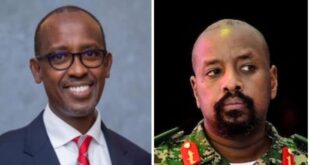
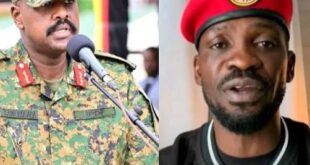

Uganda’s political landscape is no stranger to heated exchanges, and the latest salvo comes from General Muhoozi Kainerugaba, the army chief and First Son, targeting National Unity Platform (NUP) leader Robert Kyagulanyi Ssentamu, popularly known as Bobi Wine.
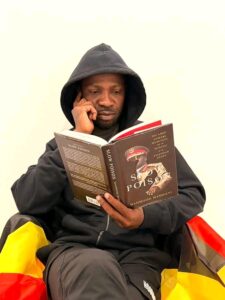
In a sharp social media post, Muhoozi wrote that Bobi Wine “takes pictures with books he cannot read like most people take with cars they’ll never drive.”
The comment drew immediate attention online, stirring debates among supporters of both the ruling establishment and the opposition.
Analysts describe it as part of a wider campaign by the army chief to question the intellectual and political capabilities of his rivals.
Gen Muhoozi’s criticism appears aimed at undermining Bobi Wine’s credibility, particularly in portraying himself as a leader capable of governing Uganda.
The post suggests that Muhoozi views some of Bobi Wine’s public gestures, including appearances with books and academic paraphernalia, as symbolic rather than substantive.
Bobi Wine, who turns 44 this year, has long been known as a charismatic figure blending music, activism, and politics.

From his humble beginnings in Nkozi, Mpigi District, he rose to fame through music, addressing social issues and advocating for youth empowerment.
His political journey began in earnest in 2017 when he was elected MP for Kyadondo East. Since then, Bobi Wine has been a vocal critic of government policies, often highlighting issues such as youth unemployment, corruption, and governance failures.
Over the years, Bobi Wine has also cultivated an image of being self-educated and culturally aware, using books and public statements to signal intellectual engagement. It is this very image that Gen Muhoozi’s comment seeks to ridicule.
The analogy Muhoozi used—comparing taking pictures with books to taking pictures with cars one cannot drive—is designed to suggest that Bobi Wine’s public gestures are performative.
According to Muhoozi, they do not translate into effective knowledge, leadership, or governance.
Social media quickly amplified the exchange, with thousands of reactions. Some commentators defended Muhoozi, arguing that political leaders must be held accountable for their qualifications and actions. Others criticized the army chief for personal attacks that could deepen political polarization.
Bobi Wine’s supporters countered by emphasizing his achievements in both music and politics.
They highlight how he has consistently used his influence to advocate for social change, inspire youth activism, and provide a voice for marginalized communities.
From a musical perspective, Bobi Wine’s rise was meteoric. Known for hits like “Freedom,” “Dembe,” and “Tuliyambala Engule,” he gained national recognition for combining entertainment with socially conscious messaging.
His music has always challenged societal norms and sparked discussions about governance and rights.
In addition to his music career, Bobi Wine has been instrumental in youth empowerment projects, including the establishment of the Ghetto Kids dance group and programs for underprivileged children. These initiatives are often cited by his supporters as evidence of practical leadership.
Muhoozi’s remarks also come amid heightened political tension in Uganda, where opposition leaders often face criticism, intimidation, and harassment. Observers note that statements like these serve both as political commentary and as a way to consolidate support among certain segments of the population.
The comment has prompted wider discussions on leadership qualifications. Some analysts argue that while symbolic gestures such as book displays are important for public image, actual performance in governance is what ultimately matters.

Bobi Wine’s campaign for the presidency in 2021, though unsuccessful, showcased his ability to mobilize young voters, use music and social media effectively, and challenge entrenched political structures. Supporters argue that such achievements demonstrate practical leadership beyond symbolic gestures.
Critics of Bobi Wine, including Muhoozi, often point to his lack of formal higher education in political science or governance as a vulnerability. The “books he cannot read” remark taps directly into this narrative, framing Bobi Wine as more style than substance.
Despite such criticism, Bobi Wine has maintained resilience. He has faced arrests, alleged harassment, and political intimidation without retreating from public life, often responding through speeches, music, and grassroots engagement rather than direct confrontation.
The social media post also illustrates the continuing use of digital platforms for political messaging in Uganda. Both Muhoozi and Bobi Wine have leveraged these platforms to communicate with citizens, shape narratives, and mobilize support.
Bobi Wine’s defenders argue that the army chief’s comment oversimplifies the contributions of an individual whose influence spans culture, youth mobilization, and politics. They note that leadership is multidimensional and cannot be measured solely by formal academic achievements.
For many Ugandans, the comment is another episode in a long-running political rivalry. While it generated attention and debate, it also highlights the high stakes of public perception, social media influence, and political symbolism in Uganda.
In the end, Muhoozi’s remark is emblematic of Uganda’s polarized political climate. It reflects the ongoing battle over credibility, public image, and leadership, where even seemingly small gestures—like posing with a book—are scrutinized, politicized, and interpreted as either genuine or performative.