
https://datawrapper.dwcdn.net/2EDfn/1/ []
Breaking News

Even A Violent & Stubborn Regime Can Be Over Thrown- Bobi Wine Warns President Museveni Not To Try Rigging Elections Or Else, He Will Order For Protest

Uganda is once again at a critical political moment as the country prepares for another general election. Millions of citizens are expected to vote, hoping that their voices will finally be heard. The political atmosphere is tense, filled with fear, hope, and uncertainty about what lies ahead.
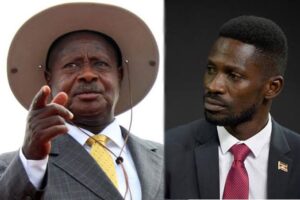
Opposition leader Bobi Wine has issued a strong warning to President Yoweri Museveni, saying that any attempt to rig the election will not be accepted. He made it clear that the people of Uganda are watching closely and are tired of stolen victories and broken promises.

Bobi Wine, whose real name is Robert Kyagulanyi, is not new to political struggle. From his early days as a musician, he used his music to speak for the poor and oppressed. Over time, his voice grew louder, turning him into a symbol of resistance and change.

President Museveni, on the other hand, has ruled Uganda for nearly four decades. His long stay in power has been supported by strong control over state institutions, the army, and the police. Many Ugandans feel that this control has weakened democracy.

Wine warned that if the election is rigged, he will call for protests across the country. He said people should not accept injustice quietly but must stand up for their rights. According to him, silence only strengthens oppression.

However, Bobi Wine emphasized that any protest must be peaceful. He openly acknowledged that the government often responds with violence, arrests, and intimidation. Still, he believes that non-violence is more powerful than guns and batons.

He reminded supporters that history has shown that even the most violent regimes can be overpowered by determined and united citizens. Change, he said, does not come easily, but it always begins with courage.

The opposition leader also urged citizens not to wait for instructions from politicians. He encouraged people to defend their votes, stay alert, and stand together as one nation determined to protect democracy.

In recent months, many of Wine’s supporters have been arrested, harassed, or blocked from campaigning. Human rights groups have raised concerns about shrinking political space and growing fear among ordinary citizens.

Despite these challenges, Bobi Wine remains firm. He says he did not promise comfort to his supporters, but truth and sacrifice. According to him, the struggle for freedom demands bravery and patience.

Uganda’s youth play a major role in this political battle. With unemployment high and opportunities limited, many young people feel forgotten by those in power. They see Bobi Wine as someone who understands their pain and speaks their language.

Wine also spoke about the wider region, pointing out that East Africa is seeing rising political unrest. Young people across the region are demanding accountability, jobs, and real democracy, not empty speeches.

When asked about foreign support, Bobi Wine said he welcomes help from the international community. However, he made it clear that Uganda must never be taken over or controlled by outsiders.

He believes that international pressure can help expose injustice and protect human rights. Still, he insisted that the true responsibility to free Uganda belongs to Ugandans themselves.

The government has repeatedly denied allegations of election rigging and repression. Officials insist that the election will be free and fair, and that security forces are only maintaining law and order.

Yet, memories of past elections remain fresh. Many Ugandans remember violence, internet shutdowns, and disputed results that left the nation deeply divided.

As election day approaches, fear and hope walk side by side. Some citizens fear bloodshed, while others believe this could be a turning point in Uganda’s history.

Bobi Wine’s message is clear: power belongs to the people, not to one man or one system. He believes that when citizens stand united, no amount of violence can silence them forever.

Whether his warning will lead to peaceful reform or further confrontation remains uncertain. What is clear is that Uganda is standing at a crossroads, with its future hanging in the balance.

As the nation waits, Bobi Wine’s words continue to echo across villages and cities: democracy is worth fighting for, justice must prevail, and even the strongest regimes can fall when the people rise together.


About West Nile

Check Also

Full List!! Here Are The 10 Cabinet Ministers Who Were Badly Defeated In Uganda’s 2026 Parliamentary Elections Uganda’s 2026 general elections have sent shockwaves across the country after ten serving cabinet ministers were badly defeated in parliamentary races. The results marked one of the most dramatic political moments in recent history and clearly showed a shift in voter mood. Across many regions, Ugandans used their votes to express frustration with long-serving leaders. The defeats reflected growing anger over economic hardship, unemployment, poor service delivery, and unfulfilled campaign promises. One of the most surprising losses was that of Beatrice Anywar, the Minister of Water and Environment. She lost the Kitgum Municipality seat to opposition candidate Dennis Onekalit Amere, ending her long political journey in Parliament. Anywar was once considered a strong political force, having served both in opposition and later in government. Her defeat shocked many supporters and showed how quickly political fortunes can change. In Ndorwa West County, David Bahati, the State Minister for Trade, Industry and Cooperatives, was also voted out. Bahati had lost the NRM primaries and chose to contest as an independent candidate. Despite his influence in the Kigezi region, voters rejected him at the ballot. His defeat marked the end of a long period of dominance and showed growing voter confidence in challenging powerful figures. One of the most talked-about races happened in Lira City, where two sitting cabinet ministers competed for the same seat. Betty Amongi, the Minister of Gender, Labour and Social Development, lost the Lira City Woman MP seat. She was defeated by Dr. Jane Ruth Aceng, the Minister of Health. This contest attracted national attention and highlighted internal competition within the ruling political class. Amongi’s defeat was widely seen as a strong message from voters who were unhappy with her political choices and leadership style. The loss also showed that holding a cabinet position does not guarantee victory. Another major defeat was that of Hamson Obua, the Government Chief Whip. He lost the Ajuri County seat despite his senior role in Parliament and close ties to the ruling party. Political analysts say Obua’s loss reflected growing dissatisfaction in northern Uganda, especially among young people facing unemployment and limited opportunities. Several other ministers were also swept out of Parliament. Moriku Kaducu, the State Minister for Primary Education, lost the Moyo District Woman MP race after a tough contest. John Mulimba, the State Minister for Foreign Affairs in charge of Regional Affairs, also failed to secure re-election. His loss added to the growing list of senior officials rejected by voters. In Chua County, Okello Oryem, the State Minister for Foreign Affairs responsible for International Affairs, was voted out. His defeat was another blow to the government’s top leadership. Frederick Ngobi Gume, the State Minister for Cooperatives, lost his Bulamogi North West seat in Kaliro District. Voters there chose change over continuity. Florence Nambozo Wamala, the State Minister for Karamoja Affairs, was defeated in the Sironko Woman MP race. Her loss showed that even regional ministers were not spared by voters. The final minister on the list was Peter Lokeris, the Minister for Karamoja Affairs, who lost the Chekwii East County seat. His defeat ended a long political career in Parliament. Across the country, voting patterns showed a strong desire for political renewal. Many voters openly supported new faces, especially in areas where leaders had stayed in power for many years. Opposition parties and independent candidates made strong gains, particularly in urban areas. At the same time, traditional ruling party strongholds showed clear signs of weakening. Political commentators described the election as a referendum on government performance. Many voters were unhappy with rising living costs, poor services, and lack of accountability. The loss of ten cabinet ministers has placed pressure on President Yoweri Museveni to rethink his Cabinet. While the law allows him to appoint ministers from outside Parliament, the defeats carry strong political meaning. NRM insiders admit that keeping defeated ministers in Cabinet could cause tension, especially as newly elected MPs push for leadership roles. As Uganda prepares for the 12th Parliament, one thing is clear. The House will be younger, more competitive, and less predictable than before. The 2026 elections delivered a powerful message from the people: no position is guaranteed, and even the most powerful ministers can be voted out.

Leave a Reply

Your email address will not be published. Required fields are marked *