Related Articles

President Yoweri Museveni has sparked a fresh wave of political drama after accusing opposition leader Robert Kyagulanyi, popularly known as Bobi Wine, of ferrying supporters to his campaign rallies in an attempt to create an illusion of widespread support. In a sharp statement during his End-of-Year national address, Museveni criticized what he called the “wrong politics” of the opposition and claimed that Bobi Wine was using “nomadic audiences” to boost his image on the campaign trail.
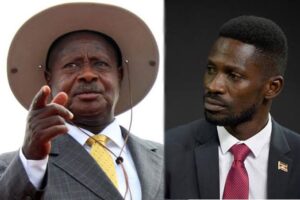
According to Museveni, these supposed supporters were not true followers of Bobi Wine but were hired individuals being transported from one rally to another to create the illusion of a massive crowd. He claimed that in Mbarara, some individuals arrested in connection with Bobi Wine’s rallies admitted to running a fleet of up to 200 vehicles, moving these “nomadic audiences” from venue to venue. This, Museveni argued, was part of a broader scheme aimed at manufacturing the appearance of widespread support.
The President accused Bobi Wine of engaging in indiscipline and what he referred to as “anarchic conduct.” He suggested that these actions were motivated not by a genuine belief in democracy but by the pursuit of power through deceitful means. Museveni emphasized that such conduct was not just a political issue but one that threatened the fabric of the country’s democracy and law.
Adding fuel to the fire, Museveni linked the actions of the opposition to foreign influences, claiming that unnamed external backers were funding such activities. These foreign entities, according to Museveni, were using opposition leaders like Bobi Wine to sow chaos and undermine Uganda’s stability. He painted a picture of foreign-backed efforts to destabilize the nation through disruptive political tactics.
The President’s comments came amidst growing tensions in the Ugandan political scene as the 2026 elections draw nearer. For months, Bobi Wine and his supporters have criticized the ruling National Resistance Movement (NRM), accusing it of manipulating the political system in favor of Museveni, who has been in power for over 35 years. Museveni’s own party, NRM, has faced accusations of using similar tactics, such as transporting people to attend rallies and inflating attendance numbers.
The President’s accusations were not limited to just the movement of supporters. He took aim at Bobi Wine’s political tactics, describing them as misleading and dangerous for the country. He claimed that the opposition was using these tactics to stir up confusion and instability in Uganda, feeding into a narrative that the ruling party was losing support.
However, this is not the first time such accusations have been levied in Ugandan politics. For years, the NRM has faced criticism for allegedly bussing supporters to attend political rallies, especially in regions like Northern and Eastern Uganda. Critics have argued that the NRM, too, engages in similar practices of inflating crowd sizes, particularly by bringing in schoolchildren and other groups who are not necessarily there out of political conviction but due to coercion or incentives.
This alleged practice of transporting supporters is seen by many as a symptom of deeper issues within Uganda’s political landscape, where genuine political engagement is often overshadowed by manipulation and control. Many Ugandans have expressed frustration over these tactics, believing that they undermine the true spirit of democracy by turning political rallies into staged events rather than genuine expressions of popular will.

Museveni’s remarks about the “nomadic audiences” also raised questions about the authenticity of political support in the country. With elections on the horizon, both the NRM and the opposition parties are vying for legitimacy and votes. The accusations of fake crowds have only added to the sense of distrust between the two sides, with each party accusing the other of engaging in deceitful practices to win over the electorate.
In the broader context, Museveni’s accusations can also be seen as a reflection of his ongoing battle to maintain control over Uganda’s political narrative. As the country faces economic challenges, corruption scandals, and a growing opposition movement, Museveni has relied heavily on portraying his leadership as the only viable option for maintaining stability. The opposition, particularly Bobi Wine’s People Power movement, has presented an alternative vision for Uganda, one that rejects the entrenched political elite and calls for a new direction.
Yet, as both sides exchange accusations, it becomes clear that the Ugandan political climate is growing increasingly polarized. Bobi Wine and his supporters have dismissed Museveni’s claims as a desperate attempt to discredit the opposition and hold onto power by any means necessary. For them, the President’s remarks are seen as an admission of fear and weakness in the face of a growing political challenge.
Despite the growing tensions, Bobi Wine has remained defiant. He has continued to criticize the government, accusing it of corruption, human rights abuses, and stifling political freedoms. His rallies, despite the accusations of inflated crowd sizes, remain highly energized and attract thousands of supporters who view him as the face of change in Uganda.
The government, on the other hand, insists that it is simply acting in the best interest of the nation, claiming that Bobi Wine’s rhetoric and actions are part of a foreign-backed conspiracy to destabilize Uganda. The President has been particularly vocal in warning the public about the dangers of foreign interference in the country’s political affairs, even as he faces growing scrutiny over his own long tenure in power.
As the 2026 elections approach, the political climate in Uganda is likely to become even more charged. The battle between Museveni’s NRM and Bobi Wine’s People Power movement is shaping up to be one of the most contentious in the country’s history. With accusations of fake crowds, foreign interference, and political manipulation flying between both sides, it is unclear what the future holds for Uganda’s democracy.
For many Ugandans, the question remains whether they will continue to tolerate the status quo or embrace a new political vision. As the political drama unfolds, both Museveni and Bobi Wine will be working tirelessly to prove their legitimacy and win the trust of the electorate.

In the meantime, the accusations of fake crowds and foreign influence will continue to dominate political discourse, adding to the growing list of issues that Ugandans will have to contend with as they head to the polls in 2026.
As the political drama escalates, the issue of foreign influence remains a key point of contention. President Museveni’s repeated claims that foreign powers are behind the opposition’s actions have stirred debate both domestically and internationally. Critics argue that these accusations are often used as a convenient excuse to deflect attention from the internal challenges facing the government, such as rising unemployment, corruption, and economic instability. On the other hand, supporters of Museveni see these claims as a necessary warning to safeguard Uganda’s sovereignty from external manipulation that could lead to instability.
The notion of “nomadic audiences” also points to deeper issues in Uganda’s political culture. In a country where political rallies often take the form of grand spectacles, the question arises: how genuine are the voices of the people in these gatherings? Are Ugandans truly mobilizing around political ideologies, or are they being used as mere props in a high-stakes game of political theater? Both the opposition and the ruling party have faced allegations of using crowd manipulation, undermining the integrity of the electoral process. This could have long-term implications for the credibility of Uganda’s democracy, as citizens may grow disillusioned with the authenticity of their political choices.
The growing tension between Museveni and Bobi Wine also underscores a generational divide within Ugandan politics. While Museveni, in power since 1986, represents the old guard, Bobi Wine symbolizes a younger generation seeking change and more representation in governance.
This generational shift is not just a political contest but also a cultural battle, as younger Ugandans, particularly the urban youth, increasingly turn their backs on the political establishment, frustrated by what they see as a failure to address their needs. For them, Bobi Wine’s rise is more than just about opposition politics; it’s about reclaiming their voice in a system they feel has long been dominated by the older, entrenched elite.
Lastly, the role of the media in these unfolding events is crucial. While social media platforms have allowed Bobi Wine to reach a vast audience, providing him with an unprecedented opportunity to communicate directly with Ugandans, traditional media outlets have often been accused of bias. Government-aligned media outlets have been accused of suppressing opposition voices, while independent media organizations have struggled to operate freely, with some journalists facing intimidation or harassment.
As a result, the Ugandan electorate is often left to navigate a highly polarized information environment, making it difficult to discern truth from political spin. In such a climate, the accuracy of claims regarding “nomadic audiences” or foreign interference becomes a matter of public perception, with each side working hard to shape the narrative in their favor