The political temperature in Uganda reached new heights recently when Speaker of Parliament, Rt. Hon. Anita Annet Among, launched a strong rebuttal to opposition leader Robert Kyagulanyi, popularly known as Bobi Wine. Her comments, made during a rally in Gomba District, have ignited a fierce debate about Uganda’s political future.
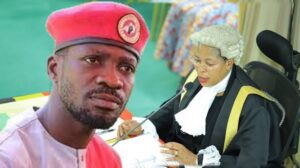
Among rejected Bobi Wine’s prediction that President Yoweri Kaguta Museveni’s rule would end in 2026. She confidently stated that Museveni’s leadership would continue well beyond that year, and the National Resistance Movement (NRM) would remain at the helm of the country.
The confrontation comes after Bobi Wine, while campaigning in Bukedea, accused the government of blocking opposition candidates from contesting the Woman MP seat in the district.
He claimed that security forces and the Electoral Commission had conspired to clear the way for Among’s uncontested re-election. Bobi Wine has long been vocal about his desire to bring about change in Uganda, and he saw this as part of the system that hinders democracy and fair competition.
During his rally in Bukedea, Bobi Wine did not hold back, calling for the end of what he described as 40 years of bad leadership under Museveni. He slammed the government for neglecting essential services like clean water, healthcare, and education, while focusing on enriching the ruling elite. His words resonated with many of the local residents who attended the rally, as they expressed frustration over the current state of the country.
However, Anita Among wasted no time in dismissing Bobi Wine’s prediction of a post-2026 Uganda. Speaking to her supporters in Gomba District, she firmly stated that Museveni would stay in power beyond 2026, confidently rejecting the idea of an NRM defeat.
Among boldly claimed that the NRM would continue to lead Uganda, and the people of Uganda would not allow a change in leadership at this stage. Her remarks were seen as a direct challenge to the opposition leader’s vision of change.
Among’s statement was not just a political defense; it was an attempt to reassert the NRM’s dominance. She ridiculed Bobi Wine’s rally in Bukedea, which she described as poorly attended, claiming that only a handful of people showed up. This criticism was aimed at undermining Bobi Wine’s influence and showcasing the strength of the NRM’s support in Bukedea and across Uganda.

The NRM’s support in Bukedea was a central theme in Among’s speech. She stressed that the people in her district were overwhelmingly behind the NRM, rejecting the idea that Bobi Wine’s call for change would resonate with them. Among pointed to the crowd at her rally as proof of the widespread backing for the ruling party, contrasting it with what she termed the insignificant attendance at Bobi Wine’s gathering.
Bobi Wine’s accusations of electoral manipulation in Bukedea were also challenged by Among. She denied any involvement in the alleged conspiracy to block opposition candidates, stating that the government had nothing to do with the alleged obstruction. According to Among, the people of Bukedea had freely chosen her to represent them and had shown their support in overwhelming numbers.
As the political temperature continues to rise, Bobi Wine and Among have become two of the most influential figures in Uganda’s political landscape. While Bobi Wine remains committed to his campaign for change and the promise of a brighter future for Uganda, Among continues to defend the NRM’s track record, emphasizing the party’s achievements under Museveni’s leadership.
The battle for Uganda’s political future is intensifying as both sides prepare for the 2026 presidential election. Bobi Wine’s National Unity Platform (NUP) has gained significant traction, especially among the youth, who are disillusioned with the status quo. The NRM, on the other hand, relies heavily on its long-standing presence and control over Uganda’s political machinery.
In Gomba, Among also addressed the issue of Uganda’s deteriorating infrastructure, particularly roads in rural areas. She highlighted the urgent need to repair the Masaka-Villa Maria highway, which has fallen into disrepair due to neglect. Among warned that failing to address such infrastructural problems now would only lead to more expensive fixes in the future. This message resonated with many in the crowd, who are keenly aware of the challenges posed by poor road networks.
Haruna Kasolo, the NRM Vice-Chairperson for Buganda Region, also spoke at the Gomba rally, calling for better training for NRM leaders on land disputes. Kasolo’s remarks highlighted the ongoing tensions in the Buganda region over land ownership and the need for more education on the provisions of the Land Act. He suggested that resolving these disputes through better leadership would help strengthen the NRM’s base in the region.
The issue of land disputes has become a point of contention between the NRM and its critics. In Buganda, where land ownership is a sensitive issue, the NRM’s handling of land conflicts has been widely criticized. Kasolo’s comments were aimed at addressing this challenge and improving the party’s standing in the region.

Despite the political rivalry, the rhetoric between Bobi Wine and Among has also highlighted the deep divisions within Uganda’s political system. On one hand, you have the established ruling party, the NRM, which has dominated Uganda’s politics for decades. On the other hand, you have the opposition, led by figures like Bobi Wine, who are challenging the old order and calling for sweeping reforms.
For many Ugandans, the upcoming 2026 elections will be a turning point. Will the NRM’s long-standing hold on power continue, or will the opposition be able to break through and usher in a new era of leadership? While Among remains confident in her party’s strength, Bobi Wine is equally determined to unseat the NRM and bring about change.
The political clash between Bobi Wine and Among is symbolic of a larger struggle for control of Uganda’s future. For some, Bobi Wine’s vision of change offers hope for a better Uganda, while others see the NRM’s leadership as the stability that the country needs to move forward.
As the 2026 election approaches, it is clear that the stakes are higher than ever. Bobi Wine’s supporters are motivated by a desire for change and an end to what they perceive as decades of misrule. Meanwhile, Among and the NRM continue to defend their record, claiming that Uganda has made significant progress under Museveni’s leadership.
For the people of Uganda, the upcoming election will not just be about choosing a new president. It will be about determining the future direction of the country. Will they continue down the path set by Museveni and the NRM, or will they embrace the promise of change offered by Bobi Wine and the opposition?
As both political figures prepare for what promises to be a fiercely contested election, one thing is certain: Uganda’s political future is at a crossroads. The outcome of the 2026 election will shape the country’s destiny for years to come, and the battle between Bobi Wine and Among is far from over. The political showdown between the two is only intensifying, and the final verdict will be determined at the ballot box.
This article highlights the political rivalry between Anita Among and Bobi Wine, examining the broader context of Uganda’s political landscape as the 2026 elections approach. The clash between the two figures is not just a battle for political power but also a contest over the future direction of the country. With both sides presenting contrasting visions for Uganda, the election will be a defining moment in the nation’s history.
