Related Articles

In a recent statement, President Yoweri Museveni hit back at opposition leader Bobi Wine, also known as Kyagulanyi, over concerns raised about the effectiveness of Uganda’s security forces in handling protests. Kyagulanyi had earlier claimed that the police and military were outnumbered by rioters, questioning whether the security forces could maintain control in the face of widespread unrest.
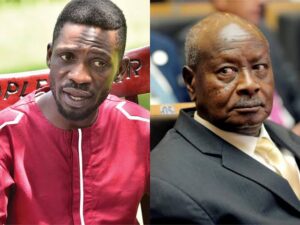
Museveni, known for his direct and no-nonsense approach to political challenges, wasted no time in addressing the issue head-on. He urged Ugandans not to believe the rhetoric coming from the opposition leader, highlighting the strength and preparedness of the country’s armed forces.
During a public address, Museveni tackled Kyagulanyi’s comments with a mixture of defiance and strategic messaging. He reassured the people of Uganda that the security forces were more than capable of handling any threat, whether from protesters or rioters. “I’ve heard Kyagulanyi say that soldiers and police are few while rioters are many,” Museveni said, speaking to an audience that included both military officials and civilians. “I advise you not to believe him. Every soldier and police officer has a gun with 120 bullets.”
This remark was designed to emphasize the firepower at the disposal of the security forces, a message that seemed aimed at undermining any perception of weakness in the face of opposition protests. Museveni’s words were not just a defense of the military but also an assertion of control, a reminder that Uganda’s security forces were fully prepared and armed to handle any situation that might arise.
The mention of “120 bullets” was no mere afterthought but a calculated effort to strike fear into the hearts of those who might consider challenging the state. By breaking down the issue into a matter of sheer numbers, Museveni painted a picture of an army that was not only well-equipped but also well-disciplined, ready to confront any threat without hesitation. This narrative served to underline the president’s confidence in his administration’s ability to maintain order and ensure stability across the country.
It was a strategic move that sought to turn the tables on Kyagulanyi’s critique, framing the opposition leader’s comments as overly simplistic and out of touch with the reality on the ground. Museveni’s message also carried an underlying warning: the security forces would not hesitate to use the necessary force to maintain peace and order, particularly in situations that involved civil disobedience or unrest.
In the context of Uganda’s recent political climate, Museveni’s remarks were particularly timely. The country has seen an increase in political protests and public demonstrations in recent years, many of which have been led by opposition groups. These protests, often sparked by frustrations with government policies and alleged electoral fraud, have at times turned violent, leading to clashes between protesters and security forces. The president’s words were therefore not just a defense of the military; they were a response to the growing discontent in the country.

Kyagulanyi, on the other hand, has long been an outspoken critic of the government, particularly with regards to issues of human rights, democratic freedoms, and the military’s role in suppressing dissent. His remarks about the security forces being outnumbered by rioters were part of a broader critique of the government’s handling of protests and its increasingly authoritarian tactics. For many of his supporters, these comments were seen as a call to action, a challenge to the government’s power and influence.
But Museveni’s response was swift and decisive, aimed at quelling any doubts about the government’s ability to maintain control. The president’s statement also served as a reminder to the Ugandan people that the military and police forces were not just tools of law enforcement, but powerful instruments of state power, ready to act at a moment’s notice if the situation demanded it.
The mention of 120 bullets per officer was an interesting choice of words, as it not only highlighted the preparedness of the security forces but also underscored the severity of the situation that the government was willing to confront. It was an implicit message that any attempt to undermine state authority would be met with overwhelming force, a message that was likely aimed at both political opponents and potential troublemakers.
At the same time, Museveni’s comments drew attention to the broader issue of governance and security in Uganda. The president’s reliance on the military to ensure stability in the country raises questions about the extent to which the state has embraced democratic principles. Critics argue that such heavy-handed tactics reflect a government that is more interested in maintaining control than in fostering genuine dialogue or addressing the underlying causes of dissent.
The use of force in the face of opposition protests has been a consistent feature of Museveni’s presidency, which spans over three decades. During this time, the Ugandan military has played a central role in suppressing political unrest, often using violent tactics to disperse protesters or to deter any challenges to the ruling government. This has led to ongoing concerns about human rights abuses, with several international organizations and local watchdogs calling for greater accountability from the security forces.
Despite the criticism, Museveni has maintained that the use of force is sometimes necessary to preserve peace and prevent chaos. His government often justifies its actions by citing the need to protect citizens from the violence that can erupt during protests, as well as the threat posed by armed opposition groups. In this sense, the president’s remarks can be seen as part of a broader narrative that frames the military as the ultimate protector of the nation, a view that resonates with many Ugandans who value stability and security above all else.
But the question remains: is the heavy reliance on military power undermining Uganda’s democratic institutions? As the country heads into the future, the challenge for Museveni and his government will be to balance the need for security with the need for democratic reforms that address the concerns of the opposition and ordinary citizens alike.
Kyagulanyi’s challenge to Museveni’s authority is not just about political differences; it is a reflection of a deeper divide within Uganda’s society. Many Ugandans feel that the government has become increasingly disconnected from the needs of the people, and that the military has become a tool for preserving the status quo rather than promoting positive change. For these individuals, the president’s words about the strength of the security forces may only serve to reinforce their fears about the direction in which the country is headed.

As Uganda continues to navigate its political landscape, the relationship between the military and the people will remain a crucial issue. The president’s comments about the security forces may have reassured some, but for others, they may have only deepened their concerns about the future of democracy in Uganda. Only time will tell how this tension will play out and whether Uganda can find a way to reconcile its security needs with the demands of a more open and democratic society.
For now, however, Museveni’s message is clear: the government will not be intimidated by opposition rhetoric, and it is fully prepared to take whatever measures are necessary to maintain order. Whether this approach will continue to resonate with the people of Uganda remains to be seen, but it is clear that the president intends to maintain a strong grip on power, regardless of the challenges that lie ahead.
As the political landscape in Uganda continues to evolve, the debate over the role of the military and the government’s handling of protests will remain central to the country’s future. What is certain, however, is that Museveni’s presidency is unlikely to be shaken by the opposition’s claims, as he remains determined to defend his government’s actions and the strength of Uganda’s security forces.
As tensions between the government and opposition continue to grow, the role of the military in Ugandan politics has become even more pronounced. Museveni’s recent remarks underline how the military is not just a force for national security but a central pillar of his regime’s survival. By framing the military as an unyielding force, the president reinforces the narrative that only through strength can Uganda avoid the chaos seen in other parts of Africa. This rhetoric plays to the fears of those who believe instability could easily spill over into violence if the opposition were to gain more influence. For many, the idea of a strong military presence offers a sense of security, even if it means curbing political freedoms.
However, there is also a growing sentiment among some Ugandans that this militarization of governance is a dangerous path. Critics argue that the military’s expanded role in civilian matters—whether in handling protests or silencing dissent—undermines democratic institutions. The presence of the military on the streets has often been associated with authoritarian regimes that value control over civil liberties. With each passing year, there is an increasing feeling that Uganda’s democracy is under threat, and many fear that Museveni’s reliance on military power will erode the very freedoms that Ugandans have fought so hard to secure.
As the nation’s political landscape becomes more polarized, Museveni’s focus on military strength may only serve to widen the divide between the government and the people. While some applaud his commitment to maintaining order, others view it as a sign of an administration unwilling to adapt to the demands for democratic reform.
The challenge for Uganda moving forward will be finding a balance between stability and political openness. As Museveni’s grip on power tightens, the question remains whether this approach will be sustainable in the long term, or if Uganda will eventually face a reckoning over the future of its democracy.