Self-proclaimed seer and fortune teller Hajji Jafari has made a bold prediction about the political future of Uganda, asserting that General Muhoozi Kainerugaba, the Commander of Defense Forces and first son of President Yoweri Museveni, will never become president, even after his father leaves office.
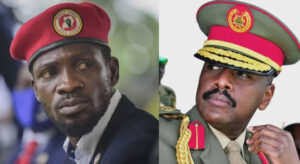
Hajji Jafari, who rose to prominence after accurately predicting that NUP President Bobi Wine would disappear immediately after casting his vote, shared his latest vision in a candid interview with a YouTuber.
He claimed that supernatural forces reveal that Gen. Muhoozi cannot ascend to Uganda’s presidency, whether he likes it or not.
According to Jafari, the period following President Museveni’s eventual exit from office will trigger a serious power struggle.
The seer explained that it may be difficult for members of the first family to maintain a unified hold on power, given the competing interests and ambitions within the inner circle.
Jafari further suggested that President Museveni may prefer to hand over power to his daughter, Natasha Museveni, rather than his son.
He argued that Natasha possesses the capacity and leadership qualities required to govern effectively, in contrast to Gen. Muhoozi.
The seer also offered commentary on the current influence of First Lady Janet Kataha Museveni.

According to Jafari, Janet wields significant authority in Statehouse decisions, and even President Museveni respects her guidance. Her influence, he claimed, shapes much of what happens in the country.
Jafari elaborated that Janet has the unique ability to convince President Museveni to leave power peacefully. This, he said, demonstrates her command over the political machinery, suggesting that she is a decisive force in shaping succession plans.
He speculated that Janet’s ambitions could favor her daughter Natasha over her son Muhoozi, implying a possible matrilineal influence in Uganda’s future leadership. This, he said, could redefine the expectations of first family succession in Ugandan politics.
The seer also weighed in on Gen. Muhoozi’s current actions. He criticized Muhoozi’s alleged involvement in politically violent activities, including targeting opposition supporters, whom Jafari labeled as “NUP terrorists.” According to the seer, these actions have caused friction within the first family.
He claimed that Muhoozi’s aggressive stance against opposition figures, including attacks on public personalities like Barbie Itungo, has angered his sisters, who reportedly feel distressed by the negative attention and tension it creates.
Political analysts observing Jafari’s statements note that such predictions, though supernatural in nature, resonate with the public because of his prior successes, particularly the Bobi Wine prediction, which bolstered his credibility.
Hajji Jafari further argued that the political landscape in Uganda will not automatically favor the eldest son. He stressed that factors such as public perception, internal family dynamics, and political alliances will play a decisive role in determining leadership succession.
According to Jafari, the post-Museveni era could be turbulent. He claimed that the first family may face challenges in consolidating power, with competing ambitions from within and outside the family likely to emerge.
The seer’s vision also highlights the significant role of women in the first family’s political dynamics. He argued that Janet’s influence and Natasha’s potential leadership capacity position them as key players in shaping Uganda’s future leadership.
Observers note that these claims, though speculative, are generating debate about the role of succession in Uganda, the influence of first family members, and the possibility of alternative leadership pathways beyond the first son.

Jafari cautioned that Gen. Muhoozi’s current strategies, particularly actions perceived as aggressive or violent, could undermine his political prospects. He emphasized that leadership requires more than military strength; it demands wisdom, public support, and family cohesion.
The fortune teller also touched on the notion of public perception, suggesting that the Ugandan populace and political actors may not support Muhoozi as a successor if tensions within the first family continue.
He warned that internal family disputes could become a critical factor in determining leadership outcomes, with decisions influenced as much by personal dynamics as by formal governance structures.
Political commentators have pointed out that Jafari’s statements may reflect broader anxieties about succession in Uganda, highlighting both the concentration of power in the first family and uncertainties surrounding its future distribution.
The seer concluded that President Museveni’s eventual decision to leave power may align with his family’s strategic preferences rather than automatic expectations for his eldest son. He reiterated that Natasha could emerge as a favored successor if Janet’s influence guides the transition.
Ultimately, Hajji Jafari’s prediction paints a picture of a complex and potentially contentious post-Museveni era, emphasizing the interplay between family dynamics, personal actions, public perception, and political ambition.
Whether one views it as prophecy or speculation, it has captured the attention of Ugandans keenly following the succession debate.
