Shock and intense political debate have swept across Uganda following explosive allegations by UNAIDS Executive Director Winnie Byanyima, who claims that President Yoweri Museveni has a secret plan to govern the country alongside his son, Gen Muhoozi Kainerugaba.
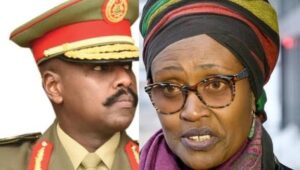
The claims have reignited long-standing concerns about succession politics, constitutional manipulation, and the future of democracy in Uganda, especially as the country edges closer to the 2026 general elections.
Speaking from her home in Kasangati on Tuesday, Byanyima alleged that President Museveni intends to use his current term to prepare and formalize a power-sharing arrangement with his son during the 2026–2031 presidential period. According to her, this plan would fundamentally alter how Uganda is governed and undermine the constitutional principle that power belongs to the people.
Byanyima further claimed that her husband, veteran opposition leader Dr Kizza Besigye, is currently imprisoned not because of any crime but because of his knowledge of and resistance to this alleged plan. She insisted that Besigye’s detention is political and intended to remove a key obstacle to Museveni’s succession agenda.
“President Museveni has a plan in this term to install his son so they can govern the country together,” Byanyima stated firmly. “Besigye knows about that plan and he disagrees with it. This is why he is imprisoned.” Her words immediately sparked widespread reaction both within Uganda and internationally.
She described Besigye as a principled leader who has consistently opposed what he views as the personalization of state power. According to Byanyima, Besigye’s refusal to stay silent made him a target of the state, resulting in repeated arrests, harassment, and now what she calls fabricated charges.
Byanyima strongly criticized the treason charges against her husband, dismissing them as false, malicious, and designed to intimidate not only Besigye but all opposition voices. She argued that the charges lack evidence and are instead meant to create fear and discourage political dissent.

She warned that such actions signal a dangerous shift toward authoritarianism, where legal institutions are allegedly being used as tools to suppress opposition rather than protect justice and the rule of law. In her view, Uganda is entering a critical phase where democratic safeguards are under serious threat.
Byanyima went on to caution that President Museveni may attempt to amend the Constitution to legitimize the alleged power-sharing arrangement with his son. She claimed that such amendments could be rushed through Parliament, relying on the ruling party’s numerical strength and loyalty.
“The next five years will be very challenging,” Byanyima said, noting that the President appears to be preparing for a future in which he maintains control while easing his son into leadership. She suggested that Museveni’s advanced age may be driving his desire to secure his legacy and family’s influence.
She expressed concern that Parliament, which should act as a check on executive power, may instead be used to rubber-stamp controversial constitutional changes. According to her, this would further weaken public trust in democratic institutions.
The idea of changing Uganda’s governance structure is not new. In the past, discussions have surfaced about altering how the president is elected, including proposals that would see the president chosen by Members of Parliament instead of through a direct popular vote.
Such proposals have been widely criticized by civil society groups, opposition politicians, and constitutional experts, who argue that they would strip citizens of their democratic right to choose their leader.
Even within government, the idea has faced resistance. Veteran minister Kahinda Otafiire has openly opposed any move to deny Ugandans the right to elect their president, warning that such changes could destabilize the country.
The allegations have also revived debate around Gen Muhoozi Kainerugaba’s increasing political visibility. Over the years, his public statements, military promotions, and social media activity have fueled speculation that he is being positioned as Museveni’s successor.

Muhoozi’s controversial remarks, including those touching on opposition figures and national security matters, have often drawn public outrage and raised questions about his political intentions.
Tensions escalated further after Muhoozi reportedly made inflammatory statements involving Winnie Byanyima and Dr Besigye, including comments that many Ugandans viewed as threatening and inappropriate for a senior military officer.
Byanyima has long been an outspoken critic of the Museveni government, both locally and internationally. She has repeatedly condemned corruption, human rights abuses, and what she describes as the steady erosion of democratic values in Uganda.
Her criticism has frequently attracted personal attacks from regime sympathisers, many of whom reference her past romantic relationship with President Museveni in an attempt to discredit her views.
Despite this, Byanyima insists that her opposition to the government is rooted in principle and love for her country, not personal history or bitterness.
She has called on Ugandans to remain vigilant and defend the Constitution, warning that silence could allow dangerous precedents to take root.
As Uganda approaches the 2026 elections, these allegations are likely to intensify political divisions and increase scrutiny of the Museveni government’s intentions. Whether the state responds to Byanyima’s claims or not, the controversy has already placed Uganda’s democratic future under a powerful spotlight.
