Related Articles



The notorious Salgaa blackspot along the Nairobi–Nakuru–Eldoret highway once again lived up to its dark reputation on Sunday evening, December 21, 2025, after a tragic road accident quickly descended into chaos, violence, and destruction.
What started as a routine journey for dozens of passengers aboard a Kampala-bound Mash Poa bus ended in fear, death, and flames, leaving the nation shocked and raising fresh concerns about road safety and mob justice along Kenya’s highways.
According to eyewitnesses, the accident occurred in the early evening hours when visibility was still fair but traffic remained heavy, as is common on this busy stretch of road. The long-distance bus, which was traveling from Nairobi toward Kampala, collided with a motorcycle carrying two people. The impact was severe, and the sound of the crash immediately drew the attention of motorists and residents nearby.
The two people on the motorcycle—a rider and a passenger—were killed instantly. Their bodies were thrown onto the road, and there was little doubt among witnesses that neither survived the collision. The sudden loss of life sent shockwaves through those who arrived at the scene, many of whom stood helplessly as they tried to understand how the tragedy had unfolded so quickly.
As news of the accident spread, a large crowd gathered within minutes. Boda boda riders from nearby stages, local residents, and passersby rushed to the scene, some out of concern and others driven by anger. The atmosphere quickly changed from shock and sorrow to rage, especially among fellow motorcyclists who believed their colleagues had been unfairly killed.
Witnesses say emotions ran extremely high as the crowd confronted the bus driver, accusing him of reckless driving and speeding. In the confusion, the driver was allegedly attacked before police intervened to rescue him from the angry mob. Many in the crowd were shouting, demanding instant justice for the two lives lost.
What followed next was a terrifying turn of events. The mob redirected its fury toward the bus itself, smashing its windows with stones and blunt objects. Inside the bus, passengers screamed in fear as glass shattered around them, forcing them to flee in panic to save their lives.
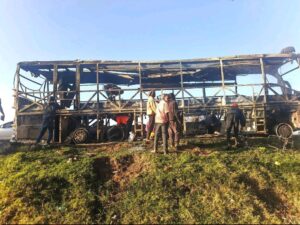
In a shocking act of violence, some individuals poured petrol on the bus and set it on fire. Within moments, flames engulfed the vehicle, spreading rapidly from the seats to the engine and roof. Thick black smoke rose into the sky as the fire roared uncontrollably.

“The anger was instant and uncontrollable,” said one eyewitness. “Before the police could fully respond, the bus was already in flames. It is only by God’s mercy that all passengers managed to escape without being burned alive.”
The inferno reduced the 65-seater bus to a mangled shell of twisted metal. Luggage, seats, and personal belongings were completely destroyed, leaving nothing but ashes behind. The burning bus lit up the evening sky, creating a scene that many described as haunting and deeply disturbing.
The destruction caused massive traffic disruption along the highway, which serves as a major transport corridor linking Nairobi to western Kenya, Uganda, and the wider East African region. Vehicles were stuck for hours, stretching for several kilometres in both directions.
Hundreds of stranded motorists waited anxiously as police officers struggled to control the crowd and restore calm. It took more than two hours for traffic to begin moving again after the wreckage was cleared from the road.
As investigations began, conflicting accounts emerged about how the accident occurred. Some witnesses claimed the bus was overtaking recklessly at high speed when it struck the motorcycle, leaving the rider with no chance to escape.
Others, however, insisted the motorcyclist may have been riding under the influence of alcohol and collided head-on with the bus. These differing versions have made it difficult to immediately establish the truth behind the fatal crash.
Police officers from Salgaa Police Station, located just a short distance from the scene, confirmed that investigations are ongoing. They are seeking to establish the exact cause of the accident and identify all individuals involved in setting the bus ablaze.

The incident drew sharp condemnation from the Motorists Association of Kenya (MAK), which described the attack on the bus as “deeply distressing and utterly unacceptable.” The association defended Mash Poa’s safety record and called for swift arrests.
The Long Distance Drivers and Conductors Association also questioned how such an act of destruction could happen so close to a police station, raising concerns about security response and enforcement in high-risk areas.
Authorities have once again warned against mob justice, describing it as a dangerous practice that destroys lives and property while denying victims true justice. They urged the public to allow law enforcement to handle such incidents legally and calmly.
As families mourn the two lives lost and dozens of passengers count their losses, the Salgaa tragedy stands as another painful reminder of the dangers on Kenyan roads and the deadly consequences of uncontrolled anger. It is a story of grief, fear, and loss—one that the country hopes will not be repeated, yet one that continues to unfold along this infamous highway.
The tragedy has once again revived painful memories of previous accidents at the Salgaa blackspot, a stretch of road that has claimed countless lives over the years despite repeated warnings and safety campaigns.
Residents and road users have long called for stricter enforcement of traffic laws, better road markings, improved lighting, and permanent police presence to curb reckless driving and reduce fatalities in the area.
Safety experts and human rights groups have also warned that mob justice only worsens already tragic situations. They argue that while anger after fatal accidents is understandable, taking the law into one’s own hands destroys evidence, traumatizes innocent passengers, and exposes communities to further loss. Many are now calling for nationwide public awareness campaigns to promote peaceful conflict resolution and respect for the rule of law, especially in high-risk zones like Salgaa.