Related Articles


BY JOSEPHINE OSANDRU MAWUA,
MADI OKOLLO, UGANDA: WEDNESDAY, JANUARY 7, 2026
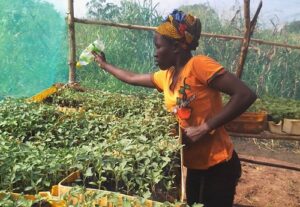
In Rhino Camp, a remarkable story of resilience and determination unfolds. Refugee women, who once fled their homes due to conflict, are now leading the charge against climate change through innovative agriculuture.
With support of dedicated organisations and the host women who offer land for the refugee women, they have gained access to training and resources that enable them to adopt smart agricultural practices.
Their gurdens are thriving providing substance for their families and communities as the surplus produce is sold at local markets generating income and empowering these women to support their loved once. As they work together, they are forging strong bonds and creating sense of community and purpose.
These women are not just adapting to their new Environment, they are taking charge of their future. As they tend to their crops, they are also nurturing hope and resilience showing the world that even in the face of adversity, individuals can make a difference.
Their story is a beacon of hope, demonstrating the impact that can be achieved through support, determination, and a passion for positive change.
Despite the unbearable heat waves due to rising temperatures caused by drastic climate change coupled with scarcity of water, living in a refugee settlement has been a mind-blowing experience for many women, especially mothers in Rhino Camp Refugee settlement in Madi Okollo District, West Nile sub region.
Located about 10km west of River Nile, Rhino Camp refugee settlement currently experiences high daytime temperatures flaring between 32 and 42 degrees Celsius according to Uganda meteorological daily weather forecast.
The heat wave which has become unbearable for many of the refugees and host communities, especially children and breastfeeding mothers, has led to acute food shortage after most food crops dried up and the long drought resulted into low harvests for many farmers in the area.
The unbearable heat waves and scarcity of water pushing many refugees and host communities to the walls of doom, women in Omugo, ocea and Siripi zones in Rhino Camp Refugee Settlement in Madi Okollo District have adopted a number of modern farming approaches to maneuver their way towards a better livelihood.
These include setting up green houses, better seed handling and nursery bed preparations, small scale irrigation, using local materials for mulching and manure production, effective pest and disease management and sustainable agronomic practices.
The refugee women are now using these climate-smart agricultural practices for growing vegetables like cabbage, nakati, onions, Tomatoes among others for both home consumption and for sale. This has greatly improved their livelihood and alienated them out of economic vulnerability and hunger.
The refugee women have now boosted their capacity and are expanding their farm businesses, thanks to support with trainings and equipment from humanitarian organizations working in Rhino Camp refugee camp like Dan Church Aid (DCA) and PALM CORPS among others.
Annet Angujeru, a female farmer in Ngurua village in Siripi zone Rhino camp refugee Settlement says she came to the area when she was joining senior one in 2018. She was able to get a chance for training in farming under PALM CORPS.
During COVID19 pandemic that they underwent a six months training as youth on growing of crops like tomatoes, cabbage, and eggplant which empowered her into farming to raise her school fees.
“After my senior four I didn’t have school fees for joining further studies but I decided to use the knowledge I gained from the PALM CORPS to start growing tomatoes out of which I was able to raise enough money to join certificate in agriculture. I had to rent land from someone but when he saw I made a lot of money, he chased me out so I looked for another land. I have now completed my certificate in Agriculture from tomato growing. I am currently planting more to enable me raise money to join diploma in august next year,” Angujeru narrates.
Similarly, Faida Moreen Ombi of the same village narrates that they use green houses to raise nursery beds for their vegetables then transplant in well-prepared gardens which improved quality and quantity of yields for me.
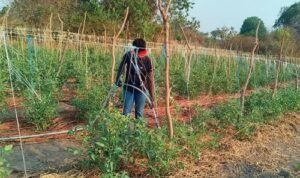
“I didn’t know how to manage greenhouse but this training has helped me. Now I grow mainly tomatoes, cabbage and African eggplant. Palm corps has changed my life. I have learnt a lot and I am still learning. The skills I have got I am not going to leave it redundant,” Faida remarks.
SAFI ALI, the site manager for one of the demonstration farms established by PALM CORPS in Siripi Zone in Rhino Camp Refugee Settlement out lines that they receive farmers on regular basis for training on climate-smart agricultural practices such as raising good seedlings, proper pest and disease management, mulching and sunken bed during dry season.
“Usually during first season we don’t get rains so we maximize the little rains we receive and encourage diverse crop planting so that when one fails, the other is there to cover up. Women are good at practicing mulching,” Safi notes.
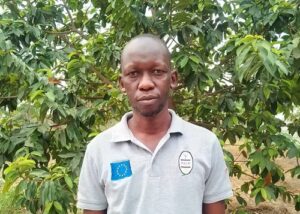
He disclosed that the demonstration farm started operating during COVID19 pandemic in 2020. They currently work with over 200 farmer groups within the refugee settlement and work with community structures through nutrition mentors and community-based facilitators to transfer the knowledge to the local farmers.
One other organization also engaging in equipping farmers in the refugee settlement with skills on modern farming is Dan Church Aid (DCA).
According to Nancy Asibazuyo, the Environment and Energy Officer at DCA, they support women from over 100 households within Omugo and Imvepi settlements.
“After the training we supported them with tree seedlings, banana suckers, vegetable seedlings and some farm tools to dig rocky arrears to harvest water. The training focusses on utilizing small rocky and unproductive land for vegetable growing and encourage them to have small bums in their compounds for growing vegetable crops for food consumption and sale,” Asibazuyo explains.
Grace Sukuran of village 1 in Omugo zone shares how the training she got from DCA on climate smart agriculture is helping her and family;
“For me I used to brew alcohol and burn charcoal but an opportunity came for training by DCA which I joined. I started growing tomatoes in the valley but later got a place upland since April last year. In a year I grow tomatoes three times. I am on it but water scarcity is affecting us badly of late. I use the money from the sales of my tomatoes for family needs and the rest to pay some people to work for me in the farm.”
William Onzima, the Natural Resource Officer for Madi Okollo District, says the District supports farmers, both the nationals and refugees within the district, including persons with disability.
The support includes extension services, trainings, workshops, offering periodic climate information leaflets to the farmers to prepare them for planting season, and distribution of seedlings among other interventions.
He adds that famers in the district have registered a lot of success stories in the sub counties of Rigbo, Ewanga and Rhino Camp.
“You find women who are growing vegetable, for example there is a woman who got over seven million shillings from a quarter acre. We are looking forward to encouraging them to embrace digital platforms to access information on market for their produce, pesticides and so on. We are also engaging Ministry of Agriculture to officer them with tablets for this purpose,” the District Natural Resource Officer discloses.
Dickson Engama, the soil fertility technician at Abi Zonal Agricultural Research and Development centre in Arua City advises farmers to do crop rotation, harvest water in the soil and practice good soil management practices such as mulching, digging deep and enriching with correct application of manure to ensure continuous cycle of production in the same garden.
He advises farmers to make their own manure using available materials like fresh vegetative cover chopped and dried to make manure.
“For communities like refugees with small land size for farming, I advise them to have some few chicken and animals like one or two goats so that the manure they generate can be incorporated into the yard and crop residues can go back to the animals. So that kind of integration is very helpful for the farmers with small land size.” Egama advises.
He says they are currently promoting pama-culture for areas with small land for farming. These include double digging where farmers are advised to dig deep beds of 45 to 60cm deep and enrich it with manure intensively, the same bed is also incorporated with biochar made out of charcoal dust.
“Such pama-culture land should be placed in the lower side of the land so that every water run-off along the slopes is captured to be stored in the garden.
Every trench can be dug 60cm wide and 2meter long, meandered within the garden. This enables every small water stored to remain moistening the land, especially when incorporated with mulching to avoid too much evaporation.” Egama stresses.
The soil fertility technician says areas in Rhino Camp Refugee settlement is categorized by high temperatures and sandy soils. He however appeals to farmers to grow plants like marigold, Retiva grass and calliandra to aid harvest materials for mulching and for fodder for the animals.
He also urges farmers to plant fruits and flowers in their gardens to aid pollination for their crops through the insects the flowers and fruits will attract. He appeals to farmers in the refugee settlement to use drought resistant healthy seeds.
With these sustainable modern agricultural practices, it is believed that farmers will be able to make reasonable money from their farming activities while conserving the environment and sustaining the harsh climatic conditions.
In Rhino camp, these refugee women are rewriting their narratives, cultivating abrighter future for themselves and their communities Their courage and perseverance serve as an inspiration to us all reminding us of the power of human spirit and the importance of community driven initiatives.
Ministry of Agriculture, Animal and fisheries from Dec 2024, is implementing a climate-smart agriculture project whose components include Strengthening Climate-Smart Agricultural Research, Seed and Agro-Climatic Information Systems, Promoting Adoption of Climate-Smart Agriculture Technologies and Practices, Market Development and Linkages for Selected Value Chains, Contingency Emergency Response Component and Project Management, Coordination, and Implementation.
For West Nile region, it is being implemented in selected districts of Adjumani with beef production as the main enterprise, Zombo for Soya beans, Yumbe for mangoes and Nebbi for Aquaculture and fisheries.
According to information obtained from the ministry web site, the project is expected to directly benefit about 760,000 households (3,900,000 individuals), and indirectly benefit approximately 1,900,000 households (9,500,000 individuals).
Among these, beneficiaries from the non-refugee districts will be about 620,000 households and 60,000 refugee households and 80,000 refugee-hosting households. This represents 65% of the total population in the project districts.